
Have you ever typed the word “scary” and then second-guessed yourself wondering if it should have two r’s instead of one? You’re not the first person to pause over this. The mix-up between scary and scarry is one of the most searched spelling questions in the English language, and the answer is simpler than most people expect.
This guide breaks it all down to the correct spelling, where the confusion comes from, grammar rules, real-life examples, and even a fun connection to a famous children’s author. By the end, you’ll never doubt yourself again.
Quick Answer: Scary vs Scarry
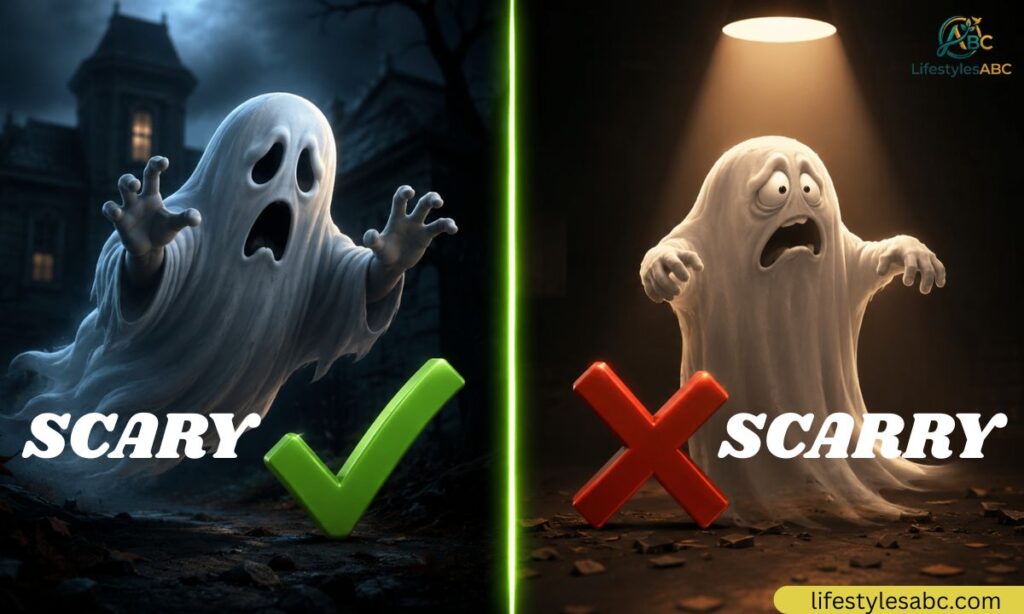
- ✅ Scary correct English word meaning something that causes fear
- ❌ Scarry a misspelling; not a standard English word
That’s the short version. Now let’s dig into why.
Simple Origin and Background
The word scary comes directly from the noun scare, which means to frighten someone. English forms adjectives from nouns and verbs by adding the suffix -y:
- Scare → Scary
- Dirt → Dirty
- Wind → Windy
Notice the pattern: the base word scare ends in a single r, and adding -y keeps it that way. There is no grammatical rule in English that would double the r here. The form scarry has no historical, etymological, or grammatical basis it simply doesn’t exist in standard written English.
Scary or Scarry Which One Is Correct?
Scary is always the correct choice.
The word scarry is never correct in standard English writing, not in American English, not in British English, and not in any other regional variety. Whether you’re writing a blog post, a school essay, a text message, or a professional email, scary is the only accepted spelling.
One important exception worth noting: Scarry exists as a proper noun specifically, as the surname of Richard Scarry, the beloved American children’s book author and illustrator. He published over 300 books (including the iconic Best Word Book Ever) and sold more than 100 million copies worldwide. His last name, an Irish surname with roots in County Galway, is pronounced just like the word “scary” but as a name, it is spelled with a double r.
So unless you’re writing about Richard Scarry the author, scary with one r is always correct.
Scarier or More Scary What’s Grammatically Correct?
When comparing two frightening things, which form do you use?
Scarier is the grammatically correct comparative form.
Here’s why: English grammar follows a rule for forming comparatives with short adjectives (typically one or two syllables). You add -er rather than using “more”:
| Form | Correct Usage |
|---|---|
| Positive | scary |
| Comparative | scarier ✅ (not “more scary”) |
| Superlative | scariest ✅ (not “most scary”) |
Examples:
- ✅ That haunted house was scarier than last year’s.
- ✅ It was the scariest film I’ve ever seen.
- ⚠️ “More scary” is widely understood but considered non-standard in formal writing.
In casual conversation, “more scary” won’t confuse anyone. In formal, academic, or professional writing, scarier is always the better choice.
Scarry Pronunciation
Since scarry is not a real word, it has no official pronunciation. However, people who ask this question are usually wondering how to say scary correctly.
Here is the standard pronunciation of scary:
- 🇺🇸 American English: /ˈsker.i/ rhymes with “hairy” or “dairy”
- 🇬🇧 British English: /ˈskeə.ri/ slightly longer vowel sound
Both pronunciations stress the first syllable: SCARE-ee.
As for the author Richard Scarry, his surname is pronounced exactly the same way like the word scary making it an easy name to say once you know the trick.
Clear Explanation of the Difference
Here is the simplest way to think about it:
Scary describes something that causes fear or alarm. It is an adjective describing a word. It tells us what kind of thing something is.
Scarry is what happens when someone types one too many letters. It looks plausible because English has many words with double consonants (carry, hurry, sorry), but the structure of the word scare does not follow that pattern.
The confusion is completely understandable and very common. Fast typing, autocorrect, and familiarity with words like “carry” or “tarry” all contribute to the mistake. The fix, however, is easy: one r, every time.
Comparison Table: Scary vs Scarry
| Feature | Scary | Scarry |
|---|---|---|
| Correct spelling | ✅ Yes | ❌ No |
| Standard English word | ✅ Yes | ❌ No |
| Meaning | Causing fear or fright | No standard meaning |
| Root word | Scare | N/A |
| Used in formal writing | ✅ Yes | ❌ No |
| Found in dictionary | ✅ Yes | ❌ No |
| Proper noun form | N/A | ✅ Richard Scarry (author) |
| American English | Scary | — |
| British English | Scary | — |
Which One Should You Use and When?
The answer is always scary in every context:
- 📝 Academic writing: The results of the experiment were scary accurate.
- 💬 Casual conversation: That movie was so scary I couldn’t sleep.
- 📱 Social media: The haunted maze was the scariest part of the night.
- 📧 Professional email: The drop in quarterly numbers is scary.
- 📖 Creative writing: A scary silence fell over the forest.
If you ever catch yourself writing scary, simply remove the extra r. One easy rule: think of the root word scare and just add -y.
Common Mistakes People Make
Understanding why people make this mistake helps you avoid it in the future.
1. Influence of similar-looking words
Words like carry, marry, tarry, and hurry all use double consonants. Writers apply that same pattern to scare by instinct but it doesn’t belong here.
2. Fast typing without proofreading
When typing quickly, an accidental double keystroke is easy to miss, especially since spell-checkers in many apps don’t always flag it.
3. Confusion between “scared” and “scary”
Some writers blur the two forms. Remember: scared = feeling fear (I was scared); scary = causing fear (It was scary).
4. Regional dialect assumptions
Some people assume there must be a British or alternative spelling but scary is identical in all forms of English worldwide.
Everyday Real-Life Examples
Here are sentences showing scary used naturally across different contexts:
- The dark forest path looked scary at night.
- Public speaking can feel scary at first.
- She wore a scary costume for Halloween.
- The thunderstorm was scary for the children.
- It’s scary how fast technology is changing.
- The doctor’s warning was a scary wake-up call.
- That clown was more funny than scary.
- Climate change presents some truly scary projections.
Each of these sentences uses scary as an adjective modifying a noun or describing a situation. This is the word’s most common function in everyday English.
Short Learning Section for Students and Beginners
If you’re learning English or just want a quick memory trick, here’s a simple breakdown:
Step 1 Find the root word: Scary comes from → scare
Step 2 Count the r’s in the root: S-C-A-R-E → one r
Step 3 Add -y: Scare → Scary → one r stays → scary ✅
Quick memory trick: “One scare, one r.”
Full word family of scary:
| Word | Type | Example |
|---|---|---|
| scare | verb | The noise scared him. |
| scared | adjective | She felt scared. |
| scary | adjective | It was a scary sound. |
| scarier | comparative | This is scarier than before. |
| scariest | superlative | The scariest night of my life. |
| scare | noun | What a scare that was! |
Frequently Asked Questions
Is “scarry” ever correct in English?
No “scarry” is always a misspelling, except as the proper surname of children’s author Richard Scarry.
What does “scary” mean?
Scary means something that causes fear, fright, or alarm; it’s an adjective describing a frightening person, place, or situation.
Is “scary” spelled the same in British and American English?
Yes, both varieties spell it scary there are no regional differences whatsoever.
What is the comparative form of “scary”?
The correct comparative is scarier and the superlative is scariest.
How do you pronounce “scary”?
American English: /ˈsker.i/; British English: /ˈskeə.ri/ both stress the first syllable.
Is “scary” a noun or an adjective?
Scary is an adjective; the related noun is fear or fright, and the verb is scare.
Can “scary” be used in formal writing?
Yes, scary is appropriate in formal, academic, and professional writing when the meaning fits.
Who is Richard Scarry?
Richard Scarry (1919–1994) was a beloved American children’s author and illustrator whose surname, spelled with two r’s, is pronounced exactly like the word scary.
What words are often confused with “scary”?
Writers sometimes type scarey, scarred, or scarry but scary is the only correct adjective form.
Why does “scarry” look like a real word?
Because common English words like carry, tarry, and marry use double consonants but since scare has only one r, its adjective form does too.
Conclusion
The difference between scary and scarry comes down to a single letter and now you know exactly which one to use. Scary is the correct, standard English adjective. It means something that causes fear or fright, comes from the root word scare, uses one r, and is spelled the same way in every variety of English. Its comparative form is scarier and its superlative is scariest.
Scarry is a misspelling, plain and simple. The one exception is the proper surname of the legendary children’s author Richard Scarry but in that case, it’s a name, not a description. The easiest rule to lock in: think of the root word. Scare has one r. Scary has one r. Every time, no exceptions.
Keep this guide bookmarked, and the next time you feel unsure, just remember one scare, one r. That’s all it takes.

Brook is the creator and author behind Healthy Leeks, a platform focused on grammar, writing skills, and English language learning. Passionate about clear communication and effective writing, Brook shares practical grammar tips, easy-to-follow language guides, and educational content to help readers improve their English with confidence.