Have you ever typed “tittle” when you meant “title” or wondered if they are even different words? You are not alone. Thousands of English learners and writers make this mistake every single day.
These two words look almost identical, but they carry completely different meanings. This guide breaks down everything clearly, so you will never mix them up again.
Quick Answer in the Simplest Form
- Title = the name of something (a book, movie, job, or person’s rank)
- Tittle = a tiny dot or mark in writing, like the dot above the letter “i” or “j”
In everyday English, title is the word you will almost always need. Tittle is real, but it is rare and mostly used in grammar or typography discussions.
Why People Get Confused
The confusion between title and tittle is easy to understand. The only visual difference is one extra letter “t” in the middle. When typing quickly, it is simple to accidentally write “tittle” instead of “title.” Both words also share the same Latin root — titulus — which is why they look and sound so similar.
Additionally, spell checkers do not always flag “tittle” as wrong because it is a genuine English word. This makes the mistake harder to spot and easier to repeat.
Tittle or Title — Which One Do You Actually Mean?
Ask yourself one simple question: Are you naming something, or talking about a tiny written mark?
- Naming a book, article, film, or person’s position → use title
- Talking about a small dot or diacritical mark in typography or writing → use tittle
For 99% of everyday writing, title is the correct choice.
Title vs Tittle Example
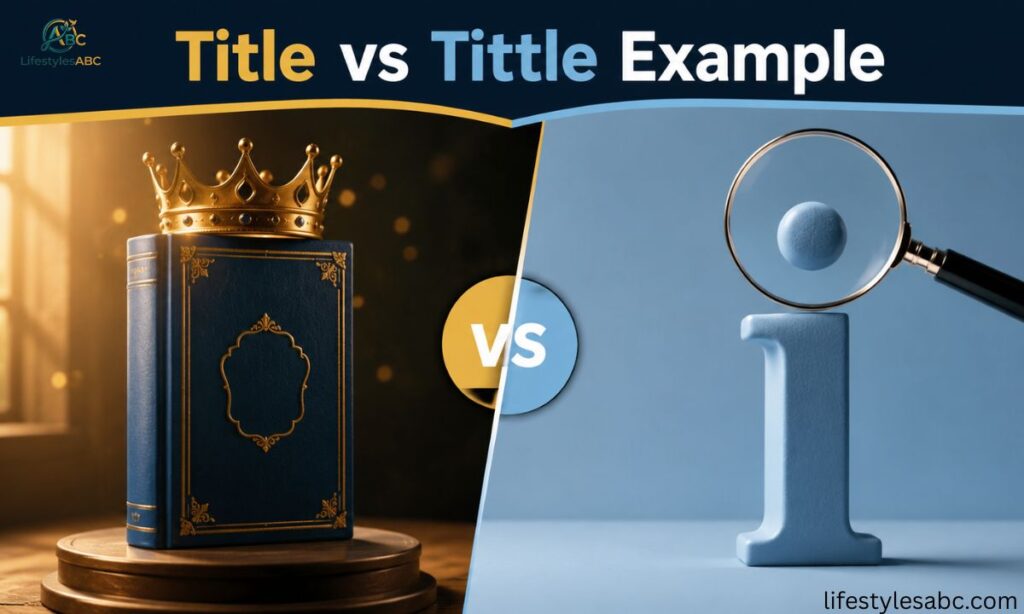
Here are two quick sentences showing the difference:
- The title of the novel caught everyone’s attention.
- The dot above the letter “i” is called a tittle.
These examples instantly show how different the two words are in actual use.
Title Meaning in English
The word title comes from the Latin word titulus, meaning a label or inscription. Over centuries of use in English, it developed several meanings:
- Name of a work — the title of a book, film, song, article, or podcast
- Job or professional rank — job title, such as Manager, Director, or Professor
- Honorific prefix or suffix — Mr., Dr., Mrs., Sir, or Lady before a name
- Legal ownership — the title to a property or land (used in legal documents)
- Heading — a chapter title, section title, or email subject line
Parts of speech:
Title works as both a noun and a verb.
- Noun: The title of the movie was confusing.
- Verb: She decided to title her book “Silent Hours.”
Tittle Meaning in English
The word tittle also traces back to the Latin titulus, but its meaning evolved differently. Today, tittle has two main uses:
- Typography/writing — a small dot, stroke, or diacritical mark that is part of a letter, especially the dot above lowercase “i” and “j”
- Informal/archaic — a very tiny or insignificant amount of something; a speck or iota
Part of speech: Tittle is only ever used as a noun. It has no verb form.
You may recognize tittle from the famous biblical phrase “not one jot or tittle” — meaning not even the smallest detail. That phrase is one of the few places where most people encounter this word today.
Clear Difference Between Title and Tittle
The core difference is simple:
Title is a name, heading, rank, or label — something that identifies a person, work, or position.
Tittle is a physical mark — specifically a tiny dot that is part of a letter’s shape, or by extension, any insignificant small thing.
One names things. The other describes a microscopic detail in writing. They are completely unrelated in modern usage despite their shared origin.
Simple Comparison Table
| Feature | Title | Tittle |
| Meaning | Name, heading, rank, or label | Tiny dot or mark; a very small amount |
| Part of speech | Noun and Verb | Noun only |
| Frequency of use | Very common (daily use) | Very rare (technical/archaic) |
| Example | The title of the report | The dot on “i” is a tittle |
| Origin | Latin titulus | Latin titulus |
| Used in | Books, jobs, films, legal docs | Typography, grammar, old texts |
| British vs American | Same spelling in both | Same spelling in both |
Easy Memory Trick to Never Forget
Here is one simple trick that works every time:
“If it NAMES something, there’s no DOUBLE trouble — use TITLE (one T in the middle).”
Think of it this way: a title gives something an identity. Tittle with the double “tt” is a tiny, almost invisible thing — just like the dot it describes.
Another way to remember:
- T-I-T-L-E → Think “This Identifies The Label Exactly”
- T-I-T-T-L-E → Think “Tiny In Typography, Too Little to Ever use”
Once this image is in your head, you will not mix them up again.
When to Use Each Word
Use Title when you are talking about:
- The name of a book, article, film, song, or TV show
- A person’s job position (job title, professional title)
- An honorific attached to a name (Dr., Prof., Mr., Ms.)
- Legal ownership of property
- A heading in a document, chapter, or section
- A sports championship (He won the world title.)
Use Tittle when you are talking about:
- The dot above the letters “i” and “j” in typography
- Diacritical marks in linguistics or language study
- An extremely small or trivial amount (in older, formal, or literary writing)
- Grammar and typography discussions
Common Mistakes Learners Make
These are the most frequent errors people make when writing these two words:
Mistake 1 — Using tittle instead of title in questions:
- ❌ What is the tittle of the book?
- ✅ What is the title of the book?
Mistake 2 — Thinking tittle is just a typo:
- Tittle is a real word — but it is rarely the word you actually need.
Mistake 3 — Treating them as synonyms:
- They are not interchangeable. Each has a distinct, specific meaning.
Mistake 4 — Using tittle in formal writing:
- In essays, emails, reports, or professional documents, always use title.
Mistake 5 — Trusting autocorrect blindly:
- Spell checkers may not catch the error because tittle is a valid word. Always check manually.
Real Life Usage Examples
Title in real sentences:
- The job title on her resume said Senior Content Strategist.
- What is the title of that song playing right now?
- He earned the title of World Chess Champion at just 22.
- Please add your title and full name at the top of the form.
- The property title was transferred to the new owner last week.
Tittle in real sentences:
- In typography, the dot above a lowercase “i” is technically called a tittle.
- The old manuscript was studied for every jot and tittle of its script.
- She argued the contract was valid down to the last jot and tittle.
- Some fonts display the tittle of “j” differently than that of “i.”
Simple Learning Section for Beginners
If you are just starting to learn English, here is everything you need in plain, simple language:
Step 1:
Remember that “title” is the word you will use almost every time. It means the name of something.
Step 2:
Know that “tittle” exists, but you may never need to use it in a school assignment, job application, or everyday conversation.
Step 3:
If you are ever unsure, ask yourself — “Am I naming something?” If yes, write title.
Step 4:
Practice with these two sentences until they feel natural:
- The title of my essay is “Climate Change.”
- The tiny dot on the letter “i” is called a tittle.
That is really all you need to know as a beginner. Keep it simple.
Frequently Asked Questions
Is “tittle” a real English word?
Yes, tittle is a real English word — it refers to a small dot or mark in writing, like the dot above “i” or “j.”
Can I use “tittle” instead of “title”?
No, they have different meanings and cannot be used interchangeably.
Why do title and tittle look so similar?
Both words come from the same Latin root (titulus), but their meanings split apart over centuries of language evolution.
Which word is more common in everyday English?
Title is far more common. Tittle is rare and mostly used in grammar or typography contexts.
Is “tittle” used in modern English writing?
Very rarely. It appears mostly in academic, literary, or typographical discussions — not in everyday speech.
Can grammar tools detect the title vs tittle mistake?
Sometimes, but not always — since “tittle” is a valid word, automated tools may miss the error if context is not analyzed.
What is the easiest way to remember the difference?
Simple rule: if you are naming something, use title. If you are talking about a tiny dot or mark, use tittle.
Conclusion
The difference between title and tittle is small in spelling but significant in meaning. Title is one of the most commonly used words in English — it names books, films, jobs, people’s ranks, and documents. Tittle, on the other hand, refers to a tiny typographical mark and is almost never used in everyday conversation.
The core rule is straightforward: if you are naming or labeling something, always write title. Reserve tittle for the rare moments when you are discussing the dot above a letter or referencing old literary texts.
Now that you understand both words clearly, you can write with full confidence. Bookmark this guide, share it with a fellow learner, and never second-guess yourself on this one again.

Brook is the creator and author behind Healthy Leeks, a platform focused on grammar, writing skills, and English language learning. Passionate about clear communication and effective writing, Brook shares practical grammar tips, easy-to-follow language guides, and educational content to help readers improve their English with confidence.