
Have you ever heard someone say “thumb in” or “thumb out” and paused for a second, wondering exactly what they meant? You are not alone. These two short phrases show up in sports coaching, body language discussions, TikTok trends, boxing gyms, and even everyday conversation yet many people still mix them up or misuse them.
The truth is, thumb in and thumb out are not complicated. But because they appear in so many different contexts, it is easy to feel confused about which one to use and when. This complete guide breaks everything down in plain English with clear definitions, real-life examples, a helpful comparison table, and memory tricks so you never forget the difference again.
Quick Answer: Thumb In vs Thumb Out
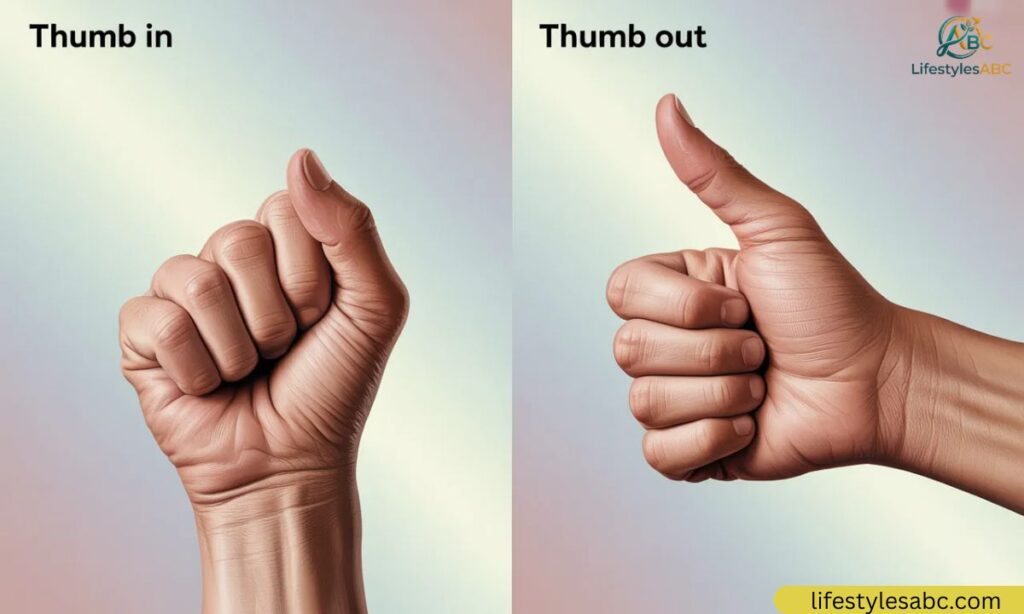
- Thumb in = the thumb is tucked inside or toward the palm of the hand.
- Thumb out = the thumb is extended or pointing away from the hand.
Both phrases are grammatically correct. The right choice always depends on the context of what you are doing, where you are, and what message you want to send.
Simple Background Explanation
Thumb In or Thumb Out Meaning
At their core, “thumb in” and “thumb out” are literal physical descriptions. They tell you where the thumb is positioned relative to the rest of the hand. That’s it: no complicated grammar, no hidden rules.
However, these same phrases have picked up layered meanings over time:
- In sports and martial arts, thumb position directly affects safety and technique.
- In body language, thumb placement sends subtle signals about confidence and openness.
- In social media and slang, especially on TikTok, “thumb in or thumb out” has become shorthand for approval, disapproval, or a romantic gesture in dance videos.
- In relationships, someone extending their thumb while holding hands is often described as a small but affectionate signal of comfort and connection.
What Does Thumb In or Thumb Out Mean in a Relationship?
In a relationship context, “thumb in or thumb out” often refers to the way two people hold hands. When one person gently wraps their thumb around the other’s fingers (thumb in), it is seen as protective and close. When the thumb rests freely on top or outside (thumb out), it can feel more casual or open. Neither is wrong, it simply reflects comfort level and personal style in physical connection.
Clear Explanation of the Difference
What Does Thumb In Mean?
“Thumb in” describes a position where the thumb is tucked inward, either:
- Folded under the fingers inside a closed fist
- Pressing toward the palm
- Hidden from view inside the hand
In boxing and martial arts, keeping the thumb in (properly wrapped around the outside of the fingers, not tucked underneath them) is the safest way to form a fist. Coaches teach beginners this technique to prevent broken thumbs and wrist sprains on impact.
In body language, thumbs tucked inward can suggest a person feels cautious, focused, or restrained. It does not always signal negativity. A student deep in concentration might naturally tuck their thumbs while thinking.
In casual or slang usage, “thumb in” sometimes means agreement or quiet approval, similar to a low-key thumbs-up.
What Does Thumb Out Mean?
“Thumb out” describes a position where the thumb extends outward or away from the hand:
- The thumb points away from the palm
- The thumb is visible and relaxed alongside the fingers
- The thumb sticks out from a closed fist in a hitchhiker-style gesture
In sports, the thumb-out position in a properly formed fist means the thumb sits along the side of the index finger not tucked underneath. This position protects the thumb during punching and allows for proper knuckle alignment.
In body language, a relaxed, extended thumb often reads as open, confident, and approachable. When someone gestures with thumbs visible and relaxed, they appear more at ease.
In everyday life, thumb out is the classic signal for hitchhiking, for “thumbs up” approval, or for pointing out a direction.
Comparison Table: Thumb In vs Thumb Out
| Feature | Thumb In | Thumb Out |
| Basic Meaning | Thumb tucked toward the palm | Thumb extended away from the hand |
| In Boxing/Martial Arts | Safer fist formation (properly wrapped) | Thumb sits alongside fingers for protection |
| In Body Language | May suggest caution, focus, or restraint | Often reads as open, confident, approachable |
| In Relationships | Protective, close hand-holding style | Casual or relaxed hand-holding style |
| In Social Media/Slang | Quiet agreement or approval | Disapproval, openness, or outward gesture |
| In Hitchhiking | Not used | Standard signal (thumb extended upward) |
| In TikTok Trends | Thumb hidden in partner’s palm during dance | Thumb kept outside for style and flair |
| Tone | Neutral to positive depending on context | Neutral to positive depending on context |
| Grammar | Correct English phrase | Correct English phrase |
Which One to Use and When
Choosing between thumb in and thumb out is never about grammar, it is always about context and clarity.
Use Thumb In When:
- Describing a fist or grip where the thumb is tucked close to the palm
- Referring to a boxing or self-defense technique that prevents thumb injury
- Talking about a hand-holding style where the thumb wraps around or under
- Using it casually to mean quiet agreement or subtle support
- Describing someone who appears focused or internally engaged
Use Thumb Out When:
- Describing a hand gesture where the thumb extends outward
- Referring to hitchhiking (the classic extended-thumb signal)
- Describing relaxed, open body language or confident gestures
- Indicating disapproval in slang or social media language
- Describing a dance move or TikTok trend where the thumb is visibly outside the hand
Common Mistakes People Make
1. Using Both Phrases as Fixed Idioms
Many people assume “thumb in” always means one specific thing and “thumb out” always means the opposite. In reality, context changes meaning.
In boxing, thumb in and thumb out both refer to proper fist technique neither is inherently negative. Always read the situation before assigning a fixed meaning.
2. Using the Wrong One in Sports
A very common mistake among beginners in boxing or martial arts is tucking the thumb underneath the fingers inside a closed fist. This is genuinely dangerous. When a punch lands with the thumb trapped under the fingers, the impact can fracture or dislocate the thumb.
The correct technique: thumb stays outside the fingers, sitting alongside the hand. This is what coaches mean when they say “keep your thumb out” during training.
3. Mixing Them in Writing
Some writers use “thumb in” and “thumb out” interchangeably, which confuses readers. For example, writing “keep your thumb in for safety” in a boxing guide, and then writing “thumb out protects your hand” two paragraphs later, sends mixed signals. Be consistent and match the phrase to its proper context.
4. Confusing with Thumbs-Up
“Thumb out” does not automatically mean thumbs-up. A thumbs-up is a specific upward-pointing gesture that signals approval. “Thumb out” simply describes the physical position of the thumb; it may or may not carry an approval meaning depending on how it is used. Treating these two phrases as synonyms leads to misunderstandings in writing and conversation.
Everyday Real-Life Examples
1. In Emails
“So, are you thumb in or thumb out on the new project timeline? Let me know your thoughts before Friday.”
Here, the phrase is used figuratively to ask whether someone is on board (in) or not convinced (out). It is a creative but clear way to ask for a decision.
2. In News or Articles
“Boxing officials continue to remind beginners: proper thumb position in or out could be the difference between a strong punch and a trip to the emergency room.”
In this context, the phrase is used technically to discuss sports safety and proper form.
3. On Social Media
“Thumb out for support 👍 Thumb in if you’re hiding from your responsibilities 😂”
Social media often uses these phrases humorously, playing with the literal and figurative meanings at the same time.
4. In Daily Conversations
“The coach keeps correcting my grip and says I have to keep my thumb out or I’ll hurt myself.”
A casual, practical use of the phrase in a sports training context.
“I noticed he always holds my hand with his thumb and it feels really safe and warm.”
A relationship context where thumb position describes a physical and emotional experience.
Short Learning Section for Students and Beginners
If you are learning English or just want to make sure you always use these phrases correctly, this section is for you.
Memory Trick
Think of it this way:
Thumb IN = Thumb goes INSIDE or INWARD.
Thumb OUT = Thumb goes OUTSIDE or OUTWARD.
That’s the whole rule. Every time you see either phrase, picture the actual thumb moving in that direction. If the thumb is going toward the palm or hiding that’s in. If the thumb is moving away or extending, that’s out.
Another way to remember:
- IN = inside, inward, invisible (tucked away)
- OUT = outside, outward, open (visible and extended)
Practice Exercise
Read the sentences below and decide: is the thumb going in or out?
- The hitchhiker extended his thumb toward passing cars.
- The coach told the student to tuck the thumb safely against the fist.
- She pointed in the direction of the store with her thumb.
- He kept his thumb hidden inside his palm during the nervous handshake.
Answers: 1 = Out, 2 = In, 3 = Out, 4 = In
Simple Sentences Practice
Try reading these sentences aloud to build natural confidence:
- “Keep your thumb in while gripping the handle.”
- “She gave a thumb out gesture to show she agreed.”
- “In martial arts, proper thumb placement in or out prevents injury.”
- “His thumb out body language made him look confident on stage.”
Frequently Asked Questions
What does “thumb in” mean?
It means your thumb is tucked inside or toward your palm. You keep it hidden or close to your hand.
What does “thumb out” mean?
It means your thumb is pointing outward or away from your hand. It is open and visible to others.
Which is safer in boxing thumb in or thumb out?
Thumb out is safer. Tucking your thumb inside your fist during a punch can break or dislocate it.
Does thumb out always mean approval?
No, not always. It depends on the situation. Sometimes it just means the thumb is pointing outward, nothing more.
What does thumb in or thumb out mean in a relationship?
It describes how someone holds your hand. Thumb it feels close and protective. Thumb out feels more relaxed and casual.
What does thumb in or thumb out mean on TikTok?
On TikTok, it is a popular trend. Thumb in means the thumb is hidden in a partner’s palm. Thumb out means it stays outside for a stylish look.
Can I use both phrases in formal writing?
Yes, you can. Both are correct English phrases. Just make sure the context is clear so readers understand what you mean.
Conclusion
Thumb in and thumb out are simple phrases, but they carry real meaning. Whether you are boxing, dancing, or holding hands, thumb position matters. Knowing the difference helps you communicate clearly and stay safe.
Always think about context before using either phrase. Thumb works best when you need control or protection. Thumb out is perfect when you want to show openness, confidence, or a gesture. Now you know exactly which one to use and when.

Brook is the creator and author behind Healthy Leeks, a platform focused on grammar, writing skills, and English language learning. Passionate about clear communication and effective writing, Brook shares practical grammar tips, easy-to-follow language guides, and educational content to help readers improve their English with confidence.