
If you have ever typed one of these words and stopped mid-sentence wondering which one is right, you are not alone.
Thousands of writers, students, and English learners search this exact question every month. The good news? The answer is simple, and by the end of this guide, you will never second-guess yourself again.
Quick Answer
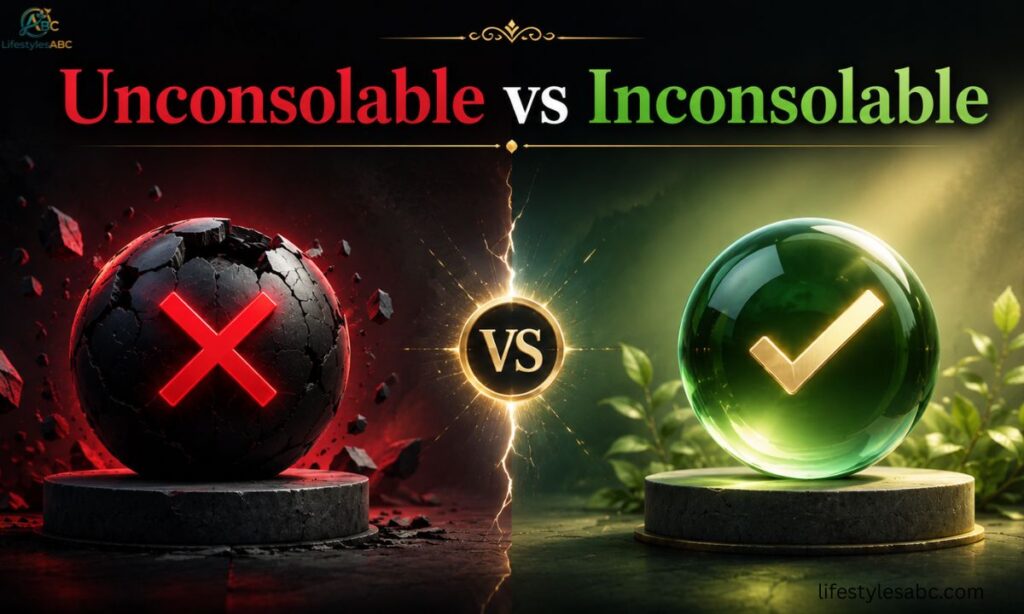
Inconsolable is the correct, standard English word. It is recognized by every major dictionary, used in formal writing, journalism, and everyday speech. Unconsolable is a nonstandard spelling that appears occasionally in informal or creative writing, but most editors, teachers, and dictionaries do not accept it as proper English.
If you need one rule to remember: always write inconsolable.
Simple Origin and Background Explanation
Understanding where these words come from clears up the confusion quickly.
The word inconsolable traces directly back to Latin. It combines:
- “in-“ (a Latin prefix meaning “not”)
- “consolabilis” (meaning “able to be comforted”)
When English borrowed heavily from Latin, it kept the original Latin prefix “in-“ for many words. That is why we say incapable, invisible, inadequate, and inconsolable, not uncapable or unvisible.
Unconsolable, on the other hand, uses the native English prefix “un-“, which also means “not.” Think of words like unhappy, uncomfortable, or unfair. Since “un-” is so familiar, writers naturally form “unconsolable” by instinct. The brain hears a logical pattern and follows it. But English standardized the Latin form centuries ago, so inconsolable became the accepted spelling.
Clear Explanation of the Difference
Here is the simplest way to think about it:
Both words try to describe the same feeling: sadness so deep that nothing brings comfort.
The difference is not about meaning. It is about correctness and acceptance in formal English.
- Inconsolable has full dictionary support (Merriam-Webster, Oxford, Cambridge)
- Unconsolable appears in some older texts and informal writing, but no major dictionary lists it as a standard entry
- In professional writing, academic papers, journalism, and formal communication, only inconsolable is appropriate
Inconsolable or Unconsolable?
Think of it this way: inconsolable is the version that has stood the test of time. It has Latin roots, dictionary backing, and centuries of use in published English. Unconsolable is the version people invent on the spot because “un-“ feels natural. Both paths lead to the same meaning, but only one is the right road in formal writing.
Comparison Table: Inconsolable vs Unconsolable
| Feature | Inconsolable | Unconsolable |
| Correct spelling | Yes | No (nonstandard) |
| Dictionary recognized | Yes (Merriam-Webster, Oxford) | Not listed |
| Prefix origin | Latin “in-“ | English “un-“ |
| Meaning | Unable to be comforted | Same idea, but nonstandard |
| Formal writing | Always acceptable | Avoid |
| Informal writing | Acceptable | Occasionally appears |
| Frequency of use | Very common | Very rare |
| British English | Correct | Not standard |
| American English | Correct | Not standard |
Which One Should You Use and When?
The answer here is straightforward. Use inconsolable in every situation.
Use inconsolable when describing:
- A person overwhelmed by grief after a loss
- A child crying so hard that nothing calms them down
- Someone experiencing emotional distress too deep for comfort
- A community devastated by tragedy or disaster
- Any emotional state where no words or actions bring relief
Avoid unconsolable in:
- Academic essays or school assignments
- Professional emails or workplace communication
- News articles, blog posts, or published writing
- Formal letters, cover letters, or applications
One simple memory trick: words borrowed from Latin almost always keep their Latin prefix. In- came with the word from Latin. Keep it there.
Common Mistakes People Make
Even experienced writers slip on this one. Here are the most common errors and how to fix them:
Mistake 1: Writing “unconsolable” in a formal essay
Wrong: The family was unconsolable after the accident. Right: The family was inconsolable after the accident.
Mistake 2: Using “inconsolable” for minor frustrations
Wrong: I was inconsolable when the Wi-Fi went out. Right: I was inconsolable after losing my grandfather.
Inconsolable describes deep, profound emotional pain. It is not the right word for small daily annoyances. Save it for situations where grief or sadness is genuinely overwhelming.
Mistake 3: Assuming both spellings are equally valid
Some websites suggest both are fine. Major dictionaries disagree. When in doubt, always side with the dictionary-backed spelling.
Everyday Real-Life Examples
Seeing a word used in real context is one of the best ways to understand it. Here are natural, everyday examples of inconsolable used correctly:
- She was inconsolable after hearing the news about her father’s passing.
- The toddler became inconsolable the moment his mother walked out of the room.
- Fans were inconsolable when their team lost the championship in the final seconds.
- He sat in the corner, inconsolable, long after everyone else had gone home.
- The whole community felt inconsolable following the sudden tragedy.
- She wrote in her journal, “I feel inconsolable today, and I do not know how to explain it.”
- The widow appeared inconsolable at the funeral, surrounded by friends who could not find the right words.
Notice how each example involves deep emotional pain, not just mild disappointment. That is the emotional weight this word carries.
Short Learning Section for Students and Beginners
If you are learning English or studying for exams, this section is for you.
Word: Inconsolable Part of speech: Adjective Pronunciation: in-KON-suh-luh-buhl Definition: So sad or upset that no comfort or support is able to help
Synonyms you can also use:
- Heartbroken
- Devastated
- Grief-stricken
- Distraught
- Disconsolate
- Despairing
Quick fill-in-the-blank practice:
- The child was __________ after losing his favorite toy. (Answer: inconsolable)
- She felt __________ when she heard the tragic news. (Answer: inconsolable)
- The family remained __________ for days after the loss. (Answer: inconsolable)
Easy memory tip:
Think of “in-“ as the key that unlocks the correct spelling. Inconsolable begins with “in” just like “incorrect” and “incomplete.” When something is wrong or missing, English often turns to “in-“.
Conclusion
The difference between unconsolable and inconsolable comes down to one thing: standard English versus a common, understandable mistake.
Inconsolable is the word every dictionary recognizes, every editor prefers, and every careful writer uses. Its Latin roots have kept it stable in the English language for centuries. Unconsolable, while logically formed and easy to understand, simply does not have a place in formal writing.
Whenever you want to describe grief too heavy to lift, pain too deep to ease, or sadness that no words can touch, the right word is always inconsolable. Write it with confidence, knowing it is correct in American English, British English, and everywhere in between.
Good writing is built on small, precise choices. This is one of them.

Brook is the creator and author behind Healthy Leeks, a platform focused on grammar, writing skills, and English language learning. Passionate about clear communication and effective writing, Brook shares practical grammar tips, easy-to-follow language guides, and educational content to help readers improve their English with confidence.