
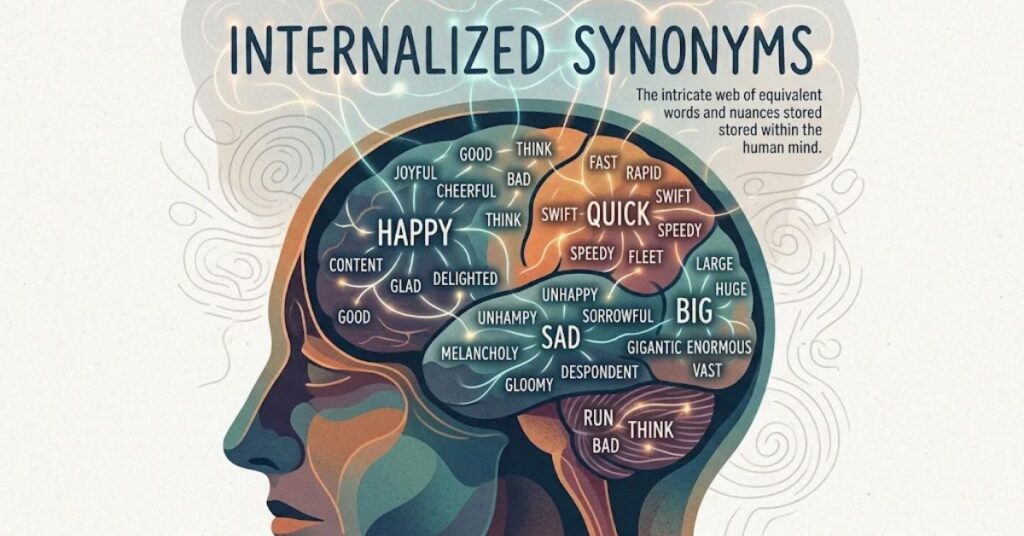
Finding the right word can make your writing clearer and more interesting. The word internalize describes how people absorb ideas, understand lessons, and accept beliefs. However, using the same word repeatedly can make your sentences sound dull. Finding an internalized synonym gives you more ways to express thoughts naturally. Words such as absorb, assimilate, embrace, and understand can describe different parts of this process. Each alternative has its own meaning and works in specific situations.
Whether you’re a student, writer, teacher, or English learner, knowing these alternatives can improve your vocabulary. Some words fit academic writing, while others sound better in everyday conversations. Understanding their differences also helps you avoid using the wrong word. Below are 30 useful alternatives with simple meanings, example sentences, and practical usage tips.
What Does “Internalize” Mean?
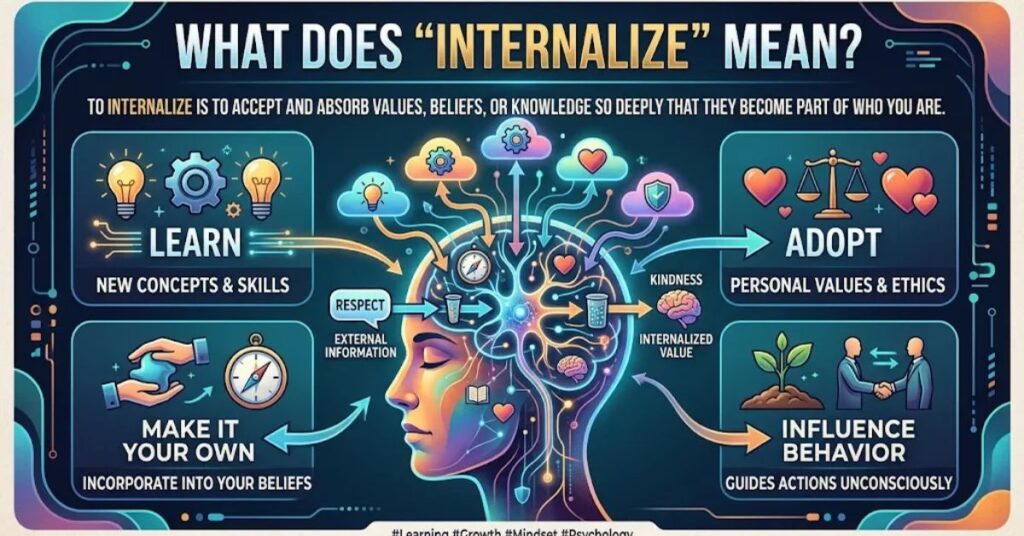
Internalize means to absorb information, beliefs, values, or experiences so deeply that they become part of your thinking or behavior. internalized synonym involves more than simply hearing or remembering something. You understand its meaning and may begin applying it in everyday life.
For example, a student might memorize a lesson for an exam. However, when that student understands the concept and uses it without constant reminders, they have internalized the knowledge.
The word appears in several situations:
- Education: Understanding and applying lessons.
- Psychology: Accepting beliefs and emotional experiences.
- Personal growth: Developing positive habits and values.
- Workplace: Adopting professional practices and company values.
- Relationships: Taking advice and feedback seriously.
Example Sentences
Here are some simple examples showing how to use internalize naturally:
- Students should internalize important concepts instead of only memorizing them.
- She internalized her teacher’s advice and improved her writing.
- Children gradually internalize the values their parents teach them.
- He needed time to internalize the feedback from his manager.
- Athletes internalize training routines through regular practice.
Usage Tip
Use internalize when describing how someone makes an idea, lesson, or belief part of their thinking. It works especially well when learning involves understanding and applying information.
Remember that related words don’t always have identical meanings.
- Absorb: To take in information.
- Assimilate: To understand and incorporate new knowledge.
- Embrace: To willingly accept an idea.
- Ingrain: To establish something deeply in the mind.
- Process: To think carefully about information.
Choose an alternative that matches your sentence and intended meaning.
1. Absorb
Meaning: To take in information, knowledge, or ideas.
Absorb is one of the closest everyday alternatives to internalize. It works well when discussing learning, reading, listening, and education. When you absorb something, you take information into your mind and begin understanding it.
Example: She absorbed every important detail from the lecture.
Best Usage Context: Learning, education, reading, and listening.
2. Assimilate
Meaning: To understand new information and connect it with existing knowledge.
Assimilate is useful in academic and professional writing. It describes how someone learns new concepts and makes them part of their existing understanding.
Example: Students need time to assimilate complicated ideas.
Best Usage Context: Academic learning, education, and professional development.
3. Incorporate
Meaning: To include something as part of a larger whole.
Incorporate works when someone adds new ideas, advice, or practices to an existing routine. It is common in business and personal development.
Example: He incorporated his manager’s suggestions into the final project.
Best Usage Context: Business, writing, and personal development.
4. Integrate
Meaning: To combine different things so they work together.
Integrate is useful when discussing knowledge, values, and professional practices. It often describes combining theory with practical experience.
Example: Students should integrate classroom lessons with practical experience.
Best Usage Context: Education, business, and workplace training.
5. Learn
Meaning: To gain knowledge or develop a new skill.
Learn is a simple alternative that fits everyday conversations. It describes gaining information through study, practice, or experience.
Example: Children learn important values through everyday experiences.
Best Usage Context: General communication, education, and training.
6. Understand
Meaning: To know the meaning of something or how it works.
Understand is useful when discussing ideas, instructions, and experiences. It focuses on recognizing meaning rather than simply remembering information.
Example: She understood the importance of discipline after joining the program.
Best Usage Context: Everyday communication and education.
7. Comprehend
Meaning: To understand something fully or clearly.
Comprehend is a more formal alternative to understand. It works well when explaining difficult subjects, complicated instructions, or academic concepts.
Example: The students comprehended the lesson after another explanation.
Best Usage Context: Academic writing and formal communication.
8. Grasp
Meaning: To understand an idea or concept clearly.
Grasp sounds natural in everyday English. It often describes the moment someone finally understands something that seemed difficult.
Example: He quickly grasped the main idea of the presentation.
Best Usage Context: Education and informal conversations.
9. Embrace
Meaning: To willingly accept an idea, belief, or change.
Embrace is useful when someone welcomes a new idea or makes it part of their personal values. It suggests positive acceptance.
Example: She embraced the lessons she learned from difficult experiences.
Best Usage Context: Personal growth, beliefs, and lifestyle changes.
10. Adopt
Meaning: To accept and begin using an idea, method, or habit.
Adopt works when someone starts following a new approach. It is common in discussions about personal development and professional practices.
Example: The team adopted a new approach to improve its performance.
Best Usage Context: Habits, beliefs, and workplace practices.
11. Accept
Meaning: To recognize or agree with something as true or valid.
Accept is useful when discussing feedback, opinions, and emotional experiences. It focuses on acknowledgment and willingness.
Example: He accepted the criticism and worked on improving his performance.
Best Usage Context: Emotional acceptance and everyday communication.
12. Digest
Meaning: To think carefully about information before responding.
Digest is a natural expression used when someone needs time to understand new information. It often appears in informal conversations.
Example: She needed time to digest the news.
Best Usage Context: Communication, education, and emotional experiences.
13. Ingrain
Meaning: To establish something deeply in someone’s mind or behavior.
Ingrain is particularly useful when discussing habits, discipline, and values. It describes something that becomes firmly established over time.
Example: Her parents ingrained the importance of honesty from childhood.
Best Usage Context: Habits, parenting, and personal development.
14. Instill
Meaning: To gradually introduce a belief, value, or quality into someone’s mind.
Instill is commonly used when parents, teachers, or leaders help others develop positive qualities.
Example: Good teachers instill confidence in their students.
Best Usage Context: Education, parenting, and leadership.
15. Embed
Meaning: To establish something deeply within a system or structure.
Embed works when discussing principles, values, and ideas that become part of a larger system.
Example: The company embedded ethical values into its workplace culture.
Best Usage Context: Business, education, and organizational culture.
16. Imbibe
Meaning: To absorb knowledge, ideas, or values through experience.
Imbibe is a formal alternative that often appears in literature and academic writing. It describes taking knowledge or wisdom into your thinking.
Example: Young professionals can imbibe valuable lessons from experienced leaders.
Best Usage Context: Formal writing, education, and personal development.
17. Retain
Meaning: To keep information in your memory.
Retain is useful when discussing learning and memory. It describes remembering information after studying or receiving it.
Example: Regular revision helps students retain important information.
Best Usage Context: Education, studying, and workplace training.
18. Memorize
Meaning: To learn something so you can remember and repeat it.
Memorize is common in education, exam preparation, and public speaking. However, remembering information doesn’t always mean understanding it deeply.
Example: She memorized the speech before the presentation.
Best Usage Context: Studying, exams, and training.
19. Personalize
Meaning: To make something personally relevant or connected to your experience.
Personalize can sometimes fit emotional situations where someone connects information with their own feelings. It can also mean customizing something for an individual.
Example: Try not to personalize every piece of constructive criticism.
Best Usage Context: Psychology, emotions, and personal experiences.
20. Identify With
Meaning: To feel connected to someone or something because of shared experiences.
Identify with is useful when discussing personal beliefs, emotions, and relationships. It describes a sense of connection rather than complete acceptance.
Example: Many readers identify with the character’s struggles.
Best Usage Context: Literature, psychology, and relationships.
21. Embody
Meaning: To represent or express an idea through actions and behavior.
Embody works when someone demonstrates particular values in everyday life. It is common in leadership and professional discussions.
Example: She embodies the organization’s values through her decisions.
Best Usage Context: Leadership, personality, and workplace culture.
22. Internalise
Meaning: The British English spelling of internalize.
Both words have the same meaning. Internalise is commonly used in British English, while internalize is preferred in American English.
Example: Students should internalise the lessons they learn.
Best Usage Context: British English and international writing.
23. Take to Heart
Meaning: To accept advice or criticism seriously and emotionally.
Take to heart is a conversational expression. It describes how someone allows advice or an experience to influence their feelings or behavior.
Example: He took his father’s advice to heart.
Best Usage Context: Relationships, advice, and personal growth.
24. Register
Meaning: To become noticed or understood mentally.
Register describes the moment information becomes clear or noticeable to someone. It is common in everyday English.
Example: The importance of her teacher’s advice finally registered with her.
Best Usage Context: Everyday communication and awareness.
25. Process
Meaning: To think carefully about information or experiences.
Process is particularly useful in psychology and communication. It describes how someone makes sense of information before responding.
Example: She needed time to process the feedback.
Best Usage Context: Psychology, emotions, and workplace communication.
26. Master
Meaning: To learn a skill or subject extremely well.
Master is useful when discussing education, sports, and professional development. It suggests a high level of knowledge or ability.
Example: He mastered the technique after months of practice.
Best Usage Context: Skills, education, and professional training.
27. Acquire
Meaning: To gain knowledge, skills, or experience.
Acquire describes developing something through learning and practice. It is common in academic and professional writing.
Example: Students acquire language skills through regular communication.
Best Usage Context: Education, language learning, and career development.
28. Cultivate
Meaning: To develop a quality, habit, or attitude gradually.
Cultivate works well when discussing personal growth and positive behavior. It suggests continuous effort and improvement.
Example: She cultivated a positive mindset through daily reflection.
Best Usage Context: Personal development, habits, and leadership.
29. Appropriate
Meaning: To take an idea or method and make it your own.
Appropriate can describe adopting or taking ownership of an idea. However, it also means suitable or proper. In cultural discussions, appropriation can carry negative meanings.
Example: The team appropriated the method and adapted it to its needs.
Best Usage Context: Academic writing and cultural discussions.
30. Familiarize
Meaning: To become acquainted with something through learning or experience.
Familiarize is useful when someone needs to understand a subject, rule, or process. It focuses on gaining knowledge and awareness.
Example: Employees should familiarize themselves with company policies.
Best Usage Context: Workplace training, education, and instructions.
Comparison Table: When to Use Different Internalize Synonyms
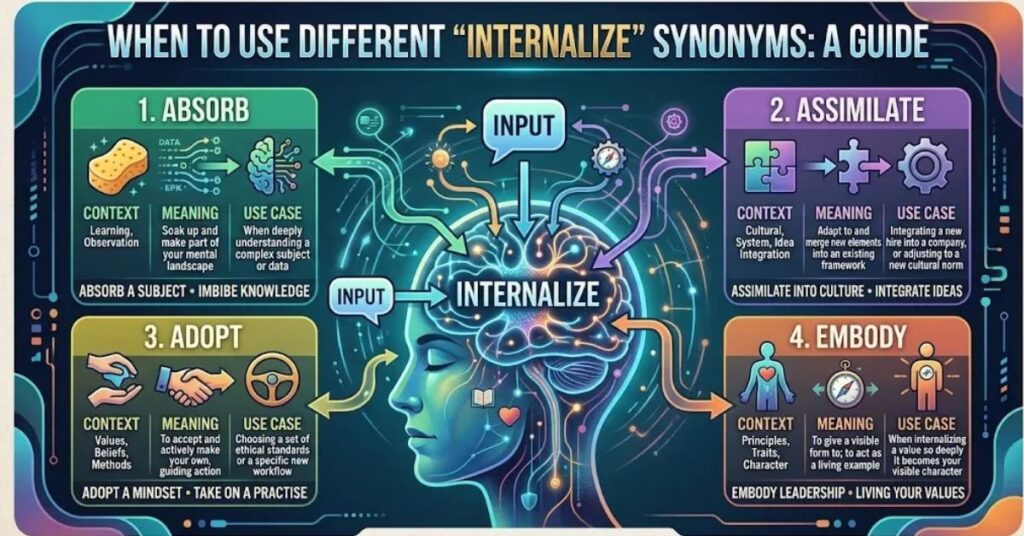
Different alternatives work in different situations. This table helps you choose a suitable word based on your intended meaning.
| Context | Suitable Synonyms |
|---|---|
| Learning and education | Absorb, Assimilate, Comprehend |
| Personal growth | Embrace, Adopt, Cultivate |
| Habits and values | Ingrain, Instill, Embed |
| Emotional acceptance | Take to Heart, Accept, Process |
| Professional development | Integrate, Incorporate, Master |
| Memory and studying | Retain, Memorize, Acquire |
| Everyday communication | Understand, Grasp, Learn |
| Personal connection | Identify With, Embody |
How to Choose the Right Synonym
The best alternative depends on what you want to communicate. Think about the situation before replacing internalize with another word.
For Learning and Understanding
Use absorb, assimilate, or comprehend when discussing education and knowledge. These words describe taking in information and understanding concepts.
Example: Students should absorb important lessons and comprehend their meaning before applying them.
For Adopting Beliefs or Values
Choose embrace, adopt, or accept when someone welcomes a belief or makes it part of their personal thinking.
Example: She embraced the importance of honesty and adopted it as a personal value.
For Habits and Long-Term Behavior
Use ingrain, instill, or embed when discussing habits and lasting behavior. These words describe how values and practices become firmly established.
Example: Parents can instill good manners while children develop healthy habits.
For Emotional Contexts
Take to heart, accept, process, and digest work well when discussing feelings or personal experiences.
Example: He took the advice to heart and needed time to process his emotions.
For Workplace and Professional Growth
Choose integrate, incorporate, master, or acquire when discussing professional skills and development.
Example: Employees can incorporate feedback into their work and master new skills through practice.
Conclusion
Learning different alternatives to internalize can improve your vocabulary and make your writing more natural. Words like absorb, assimilate, understand, embrace, and incorporate describe different ways people learn ideas, accept beliefs, and develop habits. However, each word has its own meaning. Some focus on knowledge, while others describe emotional acceptance or practical behavior.
Whether you’re writing an academic assignment or having an everyday conversation, choose a word that matches your intended meaning. Understanding these differences helps you communicate clearly and confidently. Instead of repeating the same expression, use the right alternative to make every sentence more precise.

Abu Bakar is the admin of LifestyleABC.com with 3 years of experience in grammar and language content. He specializes in English grammar, synonyms, spelling, and word usage, creating clear and practical content to help readers improve their vocabulary and communication skills.