If you have ever typed “atleast” in an email or essay and then stopped to wonder — wait, is that right? — you are not alone.
This is one of the most searched grammar questions in 2026, and the answer is simpler than most people expect. This guide breaks everything down clearly, so you never have to second-guess yourself again.
Very Quick Answer
“At least” is correct. “Atleast” is not a word — it is a spelling mistake. Always write it as two separate words. No exceptions, no regional differences, no hidden rules.
✅ Correct: “You need at least three hours to finish this.” ❌ Incorrect: “You need atleast three hours to finish this.”
Why People Get Confused
This is one of those mistakes that feels natural because of how English sounds in real speech. When you say “at least” out loud quickly, the two words blur together — the t in “at” flows right into the l in “least,” so it sounds like a single unit.
On top of that, English does combine words all the time. “Maybe,” “someone,” “already,” “however” — all were once two words. So learners and even native speakers assume “atleast” follows the same pattern. It does not.
Another big reason: fast typing. When you are texting a friend or quickly writing a message, your fingers type what your brain hears. Your brain heard one sound, your fingers typed one word.
Atleast or At Least — At Least or Atleast?
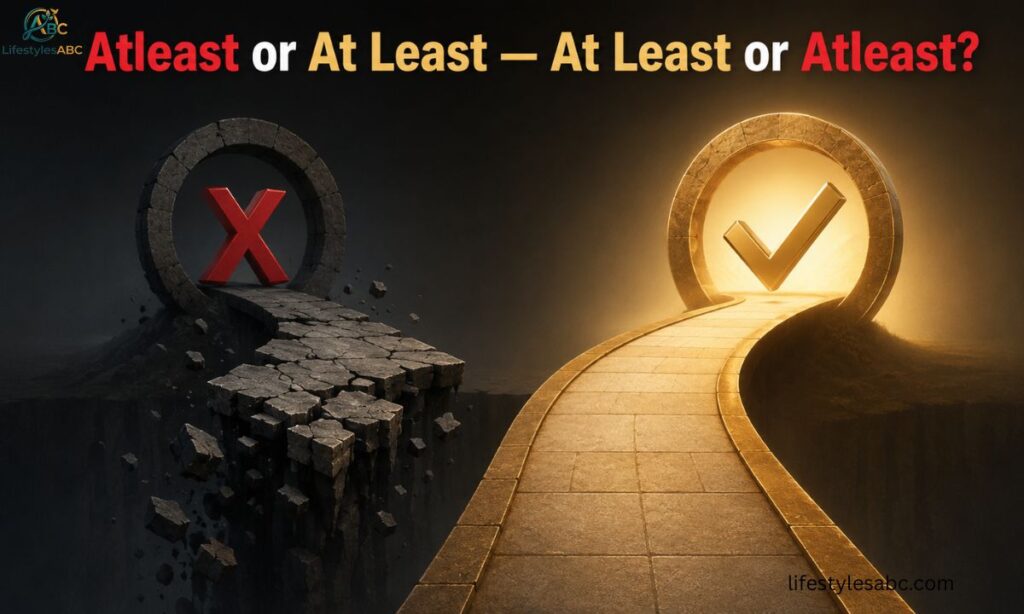
Both versions of the question point to the same answer:
- “Atleast” → does not exist in any English dictionary
- “At least” → the only correct and accepted form
Whether you search “atleast or at least” or “at least or atleast” — the answer is always the same. Two words. A space in the middle. Every time.
Simple Meaning and Background
The phrase “at least” is built from two separate words:
- “At” — a preposition that marks a point or position
- “Least” — the superlative form of “little,” meaning the smallest or lowest amount
Together, they form an adverbial phrase that has been part of standard English for centuries. It appears in Merriam-Webster, Oxford, and every major grammar guide — always as two words.
The word “atleast” has never appeared in any recognized dictionary. It is simply what happens when someone writes fast and skips the space.
Clear Explanation of the Difference
Here is the simplest way to understand this:
“At least” has three main uses in English:
- Showing a minimum amount — “Drink at least eight glasses of water a day.”
- Finding a positive side in a bad situation — “I failed the test, but at least I tried.”
- Gently correcting yourself — “She is the best in class. At least, that is what I heard.”
“Atleast” has zero uses in English — because it is not a real word.
Comparison Table: At Least vs Atleast
| Feature | At Least | Atleast |
| Correct spelling | ✅ Yes | ❌ No |
| Found in dictionaries | ✅ Yes | ❌ No |
| Acceptable in formal writing | ✅ Yes | ❌ No |
| Acceptable in informal writing | ✅ Yes | ❌ No |
| Works in British English | ✅ Yes | ❌ No |
| Works in American English | ✅ Yes | ❌ No |
| Grammar checker flags it | No | ✅ Yes |
| Number of words | Two | One (error) |
Which One to Use and When
The decision is easy: always use “at least.” But here is a quick breakdown of when and how to use it:
Use “at least” to set a minimum:
- “Submit the report at least two days before the deadline.”
- “You need at least 50% to pass the exam.”
Use “at least” to soften bad news:
- “The trip was cancelled, but at least we got a refund.”
- “It rained all day. At least we had a good book.”
Use “at least” to qualify a statement:
- “He seemed happy. At least, that is how it looked to me.”
Never use “atleast” — in any of these situations, in any style of writing, in any country. The rule is the same everywhere.
At Least vs At Most (Very Simple Difference)
People sometimes mix up “at least” and “at most” too, so here is a clean side-by-side:
| Phrase | Meaning | Example |
| At least | Minimum — this number or more | “Bring at least two pens.” (2 or more) |
| At most | Maximum — this number or less | “Bring at most two pens.” (2 or fewer) |
A handy memory trick: “at least” points upward (you need this much or more), while “at most” points downward (you can have this much or less).
And here is a bonus tip straight from grammar guides: if you remember that “at most” is two words, you will never forget that “at least” is two words too. They follow the same exact pattern.
Common Mistakes People Make
Even careful writers slip up. Here are the most frequent errors to watch out for:
- Writing “atleast” as one word — the most common mistake, caused by fast typing or speech habits
- Wrong position in the sentence — ❌ “You at least need five people” / ✅ “You need at least five people”
- Confusing “at least” with “at most” — one is a minimum, the other is a maximum
- Confusing “at least” with “at last” — “at last” means “finally after a long wait,” not a minimum
- Overusing it — saying “at least” too many times in a paragraph makes writing feel repetitive
Everyday Real-Life Examples
Here is how “at least” looks in different real-life situations:
Work and professional writing:
- “Please allow at least 24 hours for a response to your email.”
- “Sales grew by at least 15% this quarter.”
School and studying:
- “Students must score at least 40% to pass.”
- “Read at least one chapter every evening.”
Health and daily habits:
- “Walk at least 8,000 steps a day.”
- “Sleep at least seven hours every night.”
Casual conversation:
- “I didn’t win, but at least I had fun.”
- “At least the traffic wasn’t too bad today.”
Social media:
- “I walked at least 10,000 steps today — small wins!”
- “At least the food was good, right?”
Simple Learning Section for Students and Beginners
If you are new to English or preparing for an exam, this section is for you.
The rule in one sentence:
Always write “at least” as two words. “Atleast” is always wrong.
Quick memory trick: Think of it as “at” + “least” — two separate ideas, two separate words. Just like “at home,” “at school,” or “at work” — the word “at” never merges with the word after it.
Fill in the blank practice:
- Sleep _______ seven hours a night. (a) atleast (b) at least
- Bring _______ two notebooks to class. (a) at least (b) atleast
- I was nervous, but _______ I remembered the main points. (a) atleast (b) at least
Answers: All three answers are (b) at least — always two words.
Test yourself: Write five sentences today using “at least” correctly. That small habit will make the correct form feel automatic within a week.
Conclusion
The difference between “at least” and “atleast” is not a matter of opinion or style — it is a matter of correct versus incorrect. “At least” is the only accepted form in English, whether you are writing a formal report, a school essay, a work email, or a quick text message. “Atleast” is simply a common typing error, and now that you know the rule, you can catch it every time.
The next time your fingers type “atleast,” pause for half a second and add the space. That one small habit keeps your writing clean, professional, and credible — every single time.
Frequently Asked Questions
Is “atleast” ever correct?
No. “Atleast” is always a spelling mistake and is not accepted in any form of English writing.
What is the difference between “at least” and “atleast”?
“At least” is the correct two-word phrase; “atleast” is simply an incorrect spelling of the same phrase.
Can I use “at least” in formal writing?
Yes, absolutely. “At least” is perfectly appropriate in formal essays, business emails, academic papers, and professional reports.
Why do so many people write “atleast”?
Because it sounds like one word when spoken quickly, and fast typing often drops the space between the two words.
What is the difference between “at least” and “at most”?
“At least” sets a minimum (this number or more); “at most” sets a maximum (this number or less).
Is “at least” the same in British and American English?
Yes. Both British and American English use “at least” in exactly the same way — there is no regional difference.
What is a good way to remember the correct spelling?
Think: if “at most” is two words, then “at least” is two words too. They always match.

Brook is the creator and author behind Healthy Leeks, a platform focused on grammar, writing skills, and English language learning. Passionate about clear communication and effective writing, Brook shares practical grammar tips, easy-to-follow language guides, and educational content to help readers improve their English with confidence.