
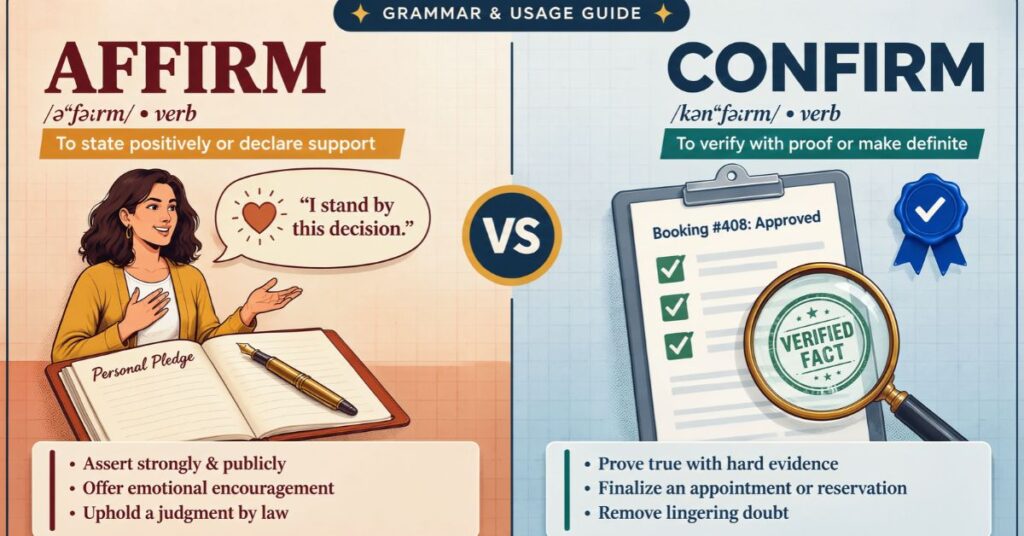
Affirm vs Confirm is a common English usage question because both words involve stating that something is true. However, they have different meanings and are not always interchangeable. Affirm generally means to state something positively, declare it to be true, or express strong support for an idea or belief. Confirm means to verify that something is true, correct, or definite, often through evidence or additional information.
Understanding this distinction can help you communicate more clearly in everyday conversations, professional emails, academic writing, and formal situations. Although the words sometimes overlap, choosing the right one depends on whether you are making a declaration or verifying information.
Quick Answer: Affirm vs Confirm
Affirm means to state something positively, declare it to be true, or express support for an idea, belief, or commitment.
Confirm means to verify, establish, or make something certain, accurate, or definite.
Easy rule to remember:
- Affirm = State, declare, or support.
- Confirm = Verify, check, or establish.
For example:
- She affirmed her commitment to the project.
- She confirmed the meeting time.
The first sentence emphasizes a declaration of commitment, while the second emphasizes verification of information.
Why Do People Confuse Affirm and Confirm?
People often confuse affirm and confirm because both words can describe expressing that something is true.
Consider these examples:
- She affirmed that she was telling the truth.
- She confirmed that she was telling the truth.
Both sentences are grammatically correct, but their emphasis differs.
Affirm focuses on asserting or declaring something positively.
Confirm focuses on verifying information or establishing certainty.
A simple way to understand the difference is:
- Affirm: “I state that this is true.”
- Confirm: “I verify that this is true.”
This distinction becomes especially important when choosing words for professional communication, formal statements, and academic writing.
What Does Affirm Mean?
Affirm is a verb that means to state something firmly, declare that something is true, or express strong support for an idea, belief, principle, or decision.
It can also mean upholding or validating something, particularly in legal and formal contexts.
Examples of Affirm
- She affirmed her commitment to the project.
- He affirmed that the statement was accurate.
- The witness affirmed that he had seen the event.
- She affirmed her belief in equal rights.
- The court affirmed the earlier decision.
Common Uses of Affirm
The word affirm is frequently used with:
- Beliefs
- Opinions
- Commitments
- Decisions
- Principles
- Statements
- Rights
- Support
For example:
The organization affirmed its commitment to improving education.
In this sentence, affirmed emphasizes a positive declaration of commitment rather than simply checking whether the commitment exists.
What Does Confirm Mean?
Confirm is a verb meaning to establish that something is true, accurate, correct, or definite.
It commonly involves checking information, receiving evidence, or verifying something that was previously suspected or believed.
Examples of Confirm
- Please confirm your email address.
- The manager confirmed the meeting time.
- The test confirmed the diagnosis.
- She confirmed that she would attend.
- The company confirmed the report.
Common Uses of Confirm
Confirm is commonly used with:
- Appointments
- Reservations
- Dates
- Times
- Information
- Details
- Facts
- Reports
- Bookings
- Suspicions
- Arrangements
For example:
Please confirm your appointment by Friday.
Here, confirm means to verify that the appointment is scheduled and definite.
Affirm vs Confirm: Comparison Table
| Feature | Affirm | Confirm |
|---|---|---|
| Main meaning | State or declare positively | Verify or establish |
| Main focus | Assertion, belief, support | Verification, certainty |
| Common use | Beliefs and commitments | Appointments and information |
| Example | She affirmed her commitment. | She confirmed the appointment. |
| Similar word | Assert | Verify |
| Typical emphasis | Making a declaration | Checking accuracy |
The Key Difference Between Affirm and Confirm
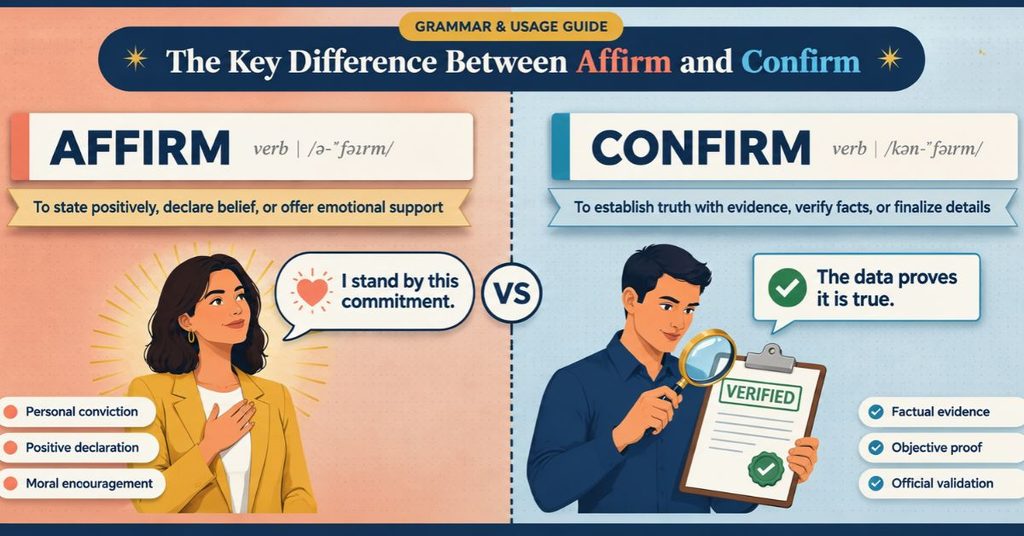
The easiest way to understand the difference is to focus on assertion versus verification.
Affirm = Assertion
When you affirm something, you make a positive statement about it or express support for it.
Example:
He affirmed his loyalty to the company.
This means he declared or expressed his loyalty.
Confirm = Verification
When you confirm something, you establish that it is true, correct, or definite.
Example:
He confirmed the meeting time.
This means he verified the information.
Compare These Examples
She affirmed her belief in the plan.
This emphasizes her belief and support.
She confirmed that the plan would begin Monday.
This emphasizes verification of the information.
Although both sentences involve expressing something as true, their purposes are different.
When to Use Affirm
Use affirm when someone:
- Makes a strong declaration.
- States something positively.
- Expresses a belief.
- Shows support.
- Reinforces a commitment.
- Upholds a principle or decision.
Examples of Affirm in Sentences
- The leader affirmed his commitment to transparency.
- She affirmed that the information was accurate.
- The student affirmed her willingness to participate.
- The court affirmed the previous ruling.
- The organization affirmed its support for the initiative.
In formal writing, affirm can sound stronger and more deliberate than simply using say or state.
When to Use Confirm
Use confirm when someone:
- Verifies information.
- Checks a fact.
- Establishes certainty.
- Validates a previous suspicion.
- Makes an arrangement definite.
- Verifies an appointment or booking.
Examples of Confirm in Sentences
- Please confirm your attendance.
- The doctor confirmed the results.
- The hotel confirmed our reservation.
- The company confirmed the news.
- Can you confirm the address?
In these situations, confirm is the natural choice because the main purpose is verification.
Affirm vs Confirm in Sentences
The following examples demonstrate how each word works in everyday English.
Affirm Examples
- She affirmed her support for the proposal.
- He affirmed his commitment to the team.
- The witness affirmed that the statement was true.
- She affirmed her belief in the principle.
- The court affirmed the lower court’s decision.
- The organization affirmed its dedication to public service.
- He affirmed that he would stand by his decision.
Confirm Examples
- Please confirm your attendance.
- The manager confirmed the meeting time.
- The test confirmed the results.
- She confirmed that she had received the email.
- The airline confirmed the booking.
- The company confirmed its new policy.
- Please confirm whether the information is correct.
These examples show that affirm usually expresses a declaration or support, whereas confirm establishes accuracy or certainty.
Can Affirm and Confirm Be Used Interchangeably?
Sometimes, yes. Both words can work when someone states that something is true, but the meaning and emphasis may change.
For example:
- She affirmed that the information was correct.
- She confirmed that the information was correct.
Both sentences are acceptable.
However, affirmed emphasizes her assertion, while confirmed emphasizes her verification of the information.
In other situations, only one word sounds natural.
For example:
Please confirm your reservation. Correct.
Please affirm your reservation. Generally unnatural.
The first sentence asks someone to verify an arrangement.
Similarly:
She affirmed her commitment to the cause. Correct.
She confirmed her commitment to the cause. Also possible, but it emphasizes acknowledging or establishing the commitment rather than expressing strong support.
Common Mistakes When Using Affirm and Confirm
Understanding these common mistakes can help you choose the correct word more confidently.
Mistake 1: Using Affirm for Appointments
Incorrect: Please affirm your appointment.
Correct: Please confirm your appointment.
Confirm is appropriate because the purpose is to verify an appointment or make it definite.
Mistake 2: Using Confirm When Emphasizing a Belief
Less natural: She confirmed her belief in the principle.
More natural: She affirmed her belief in the principle.
Although confirmed can be grammatically acceptable in some contexts, affirmed is often more appropriate when emphasizing strong belief or support.
Mistake 3: Assuming Both Words Have Exactly the Same Meaning
Affirm and confirm overlap, but their central meanings differ.
- Affirm means declare, assert, or support.
- Confirm means verify, establish, or validate.
Using the right word makes your writing more precise.
Memory Trick: Affirm vs Confirm
A simple memory trick can help you remember the difference.
AFFIRM = ASSERT
Both words involve making a positive statement.
Affirm means to assert or declare something.
CONFIRM = CHECK
Think of confirming something as checking whether it is correct.
Confirm means to verify or establish something.
Remember:
- Affirm = “I state it.”
- Confirm = “I verify it.”
This shortcut is especially useful when writing emails, answering questions, or choosing between the two verbs in a sentence.
Affirm vs Confirm in Formal and Legal English
Both words are common in formal English, but they can have specialized meanings.
Affirm in Legal English
In legal contexts, affirm can mean to uphold a decision, judgment, or ruling.
Example:
The appellate court affirmed the lower court’s judgment.
This means the appellate court upheld the earlier decision.
Affirm can also refer to making a solemn declaration instead of taking an oath in certain legal situations.
Confirm in Legal and Professional English
Confirm can mean formally establishing, validating, or approving something.
Example:
The committee confirmed the appointment.
This means the appointment was officially established or approved.
Understanding these specialized meanings is important for professional, academic, and legal writing.
American vs British English
There is no significant American-versus-British spelling difference between affirm and confirm.
Both words are standard in American English and British English.
Their basic meanings and common usage are also largely the same in both varieties.
You can use:
- Affirm for stating, declaring, or strongly supporting something.
- Confirm for verifying or establishing something.
These distinctions apply whether you are writing for a U.S. audience or a British audience.
Affirm vs Confirm vs Validate
Affirm, confirm, and validate can overlap, but they have different typical uses.
| Word | Meaning | Example |
|---|---|---|
| Affirm | State or support something positively | She affirmed her commitment. |
| Confirm | Verify that something is true or correct | She confirmed the appointment. |
| Validate | Establish that something is legitimate, acceptable, or accurate | The test validated the results. |
Choosing the most precise verb helps make your writing clearer and more professional.
How to Choose the Right Word
Ask yourself one simple question:
Am I stating or supporting something, or am I verifying it?
If you are declaring, asserting, or expressing strong support, choose affirm.
If you are checking, verifying, or establishing certainty, choose confirm.
Quick Guide
| Situation | Correct Word |
|---|---|
| State a belief | Affirm |
| Express commitment | Affirm |
| Support a principle | Affirm |
| Uphold a decision | Affirm |
| Verify a fact | Confirm |
| Verify an appointment | Confirm |
| Verify a reservation | Confirm |
| Establish information as true | Confirm |
| Check attendance | Confirm |
| Verify a booking | Confirm |
Final Verdict: Affirm vs Confirm
Affirm and confirm are related but not identical.
Affirm focuses on making a positive declaration, expressing support, or asserting that something is true.
Confirm focuses on checking, verifying, or establishing that something is true, accurate, or definite.
The easiest way to remember the distinction is affirm = assert and confirm = verify.
If you are declaring a belief or commitment, affirm is often the better choice. If you are checking information or making an arrangement definite, confirm is usually the natural choice.
Understanding this difference will help you use both words accurately in everyday conversations, professional emails, academic writing, and formal English.
FAQs: Affirm vs Confirm
Is affirm the same as confirm?
Not exactly. Affirm usually means to state or declare something positively, while confirm usually means to verify or establish that something is true or correct.
What is an example of affirm?
She affirmed her commitment to helping the community.
Here, affirmed means she strongly declared her commitment.
What is an example of confirm?
Please confirm your appointment.
Here, confirm means to verify that the appointment is scheduled or definite.
What is the synonym of affirm?
Common synonyms of affirm include assert, declare, state, proclaim, and maintain. The best synonym depends on the context.
What is the synonym of confirm?
Common synonyms of confirm include verify, validate, establish, substantiate, and authenticate.
Is confirm more formal than affirm?
Neither word is inherently more formal than the other. Both are appropriate in formal English, but affirm often appears in discussions of beliefs, commitments, and legal decisions, while confirm is common in professional communication and verification.
Can I use affirm in an email?
Yes. Affirm can be used in formal emails when expressing a belief, commitment, or strong support. However, confirm is generally more appropriate when verifying appointments, details, or arrangements.
What is the opposite of affirm?
Depending on the context, antonyms of affirm include deny, reject, contradict, and negate.
What is the opposite of confirm?
Depending on the context, antonyms of confirm include deny, disprove, refute, and invalidate.
Which word should I use: affirm or confirm?
Use affirm when you want to declare, assert, or express support for something. Use confirm when you want to verify information, establish accuracy, or make an arrangement definite.

Abu Bakar is the admin of LifestyleABC.com with 3 years of experience in grammar and language content. He specializes in English grammar, synonyms, spelling, and word usage, creating clear and practical content to help readers improve their vocabulary and communication skills.