
If you’ve ever typed “spicey” and paused to wonder whether it’s right, you’re in good company. This small spelling question trips up thousands of people every day in recipes, food blogs, text messages, and professional writing alike.
The good news? The answer is clear, simple, and once you learn it, you’ll never second-guess it again.
Quick Answer: Spicey vs Spicy
Spicy is the correct spelling. Spicey is a misspelling and should always be avoided in standard English formal or informal, American or British.
| Word | Correct? | Used In |
| Spicy | ✅ Yes | All standard English contexts |
| Spicey | ❌ No | Informal/incorrect usage only |
Origin and Background of Spicey vs Spicy
The word spicy comes from the noun spice, which entered English from Old French espice, itself rooted in Latin species (meaning a kind or type). Over time, the meaning shifted to describe strong flavor, aroma, and heat.
In English, when you form an adjective by adding -y to a word that ends in a silent “e,” the silent “e” is dropped. That’s how:
- ice → icy
- juice → juicy
- price → pricy
- spice → spicy
The spelling spicey is considered archaic; it appears in very old texts but has been out of standard use for well over a century. Google Ngram data confirms that spicey has been nearly nonexistent in published writing since the early 1900s.
Spicey or Spicy Which Is Correct?
Spicy is correct. Full stop.
No dictionary Merriam-Webster, Oxford, Cambridge, or Collins lists spicey as an accepted variant. It is treated as a spelling error in academic writing, professional content, and published media. If you used spicey in a school essay or workplace document, it would be marked wrong.
The word spicy functions as an adjective. It describes:
- Food that contains strong seasoning, chili peppers, or heat-producing spices.
- A person, conversation, or situation that is bold, exciting, or slightly controversial.
Spicey or Spicy UK Spelling
Some spelling differences exist between American and British English (like color vs colour). This is not one of them.
Both American English and British English are spicy. There is no regional exception, no alternate British form, and no situation where spicey becomes acceptable based on geography.
✅ UK: The curry was incredibly spicy.
✅ US: That salsa is way too spicy for me.
❌ Neither: She ordered a spicey dish.
Spicey vs Spicy Real-Life Examples
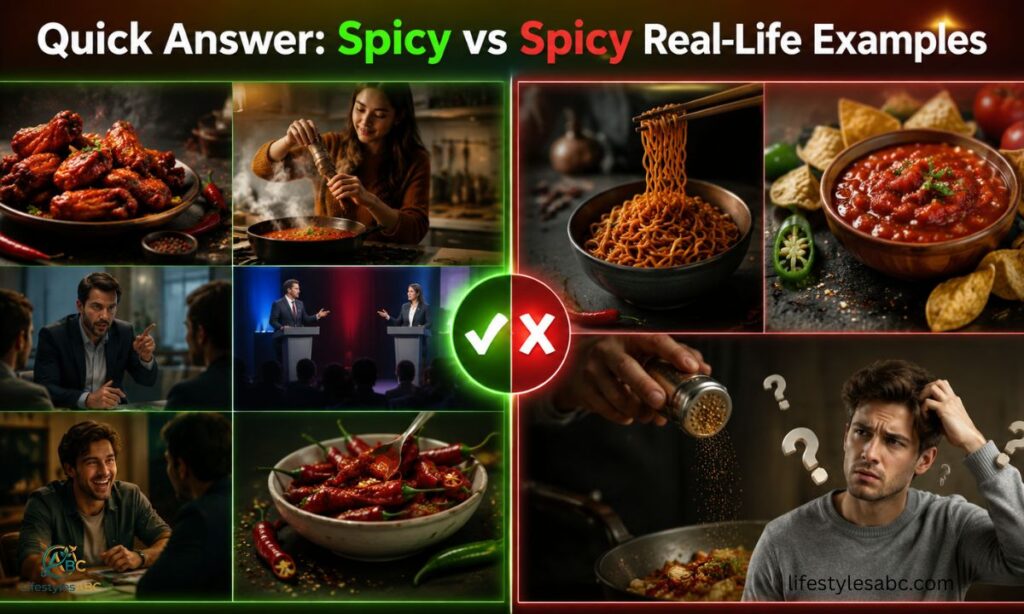
Here’s how spicy is correctly used across different everyday contexts:
Food and cooking:
- “This chili is far too spicy for my taste.”
- “She added extra pepper to make the sauce more spicy.”
- “The restaurant is known for its spicy wings.”
Figurative/informal use:
- “That was a spicy comment at the meeting.”
- “The debate took a very spicy turn.”
- “He has a spicy sense of humor.”
Incorrect examples to avoid:
- ❌ “I love spicey noodles.” → ✅ “I love spicy noodles.”
- ❌ “The salsa was too spicey.” → ✅ “The salsa was too spicy.”
- ❌ “Add spicey seasoning to the dish.” → ✅ “Add spicy seasoning to the dish.”
Difference Between Spicey and Spicy
| Feature | Spicy | Spicey |
| Correct spelling | ✅ Yes | ❌ No |
| Found in dictionaries | ✅ Yes | ❌ No |
| Used in formal writing | ✅ Yes | ❌ No |
| Used in British English | ✅ Yes | ❌ No |
| Used in American English | ✅ Yes | ❌ No |
| Origin | Standard modern English | Archaic/misspelling |
| Recommended for SEO content | ✅ Yes | ❌ No |
The only “difference” between them is that one is correct and one is not. They are not regional variants, style choices, or interchangeable forms.
Which One to Use and When
Always use spicy.
- Writing a recipe? → spicy
- Describing food on a menu? → spicy
- Posting a food review online? → spicy
- Writing a casual text to a friend? → spicy
- Describing a bold, exciting conversation? → spicy
There is no scenario where spicey is the right choice. Even in the most casual or creative writing context, the correct adjective remains spicy.
Common Mistakes People Make with Spicey vs Spicy
Mistake 1: Keeping the “e” from the base word
People see spice and assume the adjective should preserve the “e” so they write spicey. English spelling rules say drop it.
✅ Fix: Spice + y = Spicy (drop the silent “e”)
Mistake 2: Assuming spicey is the British spelling
It’s not. Both varieties of English use spicy exclusively.
✅ Fix: Use spicy regardless of your audience’s location.
Mistake 3: Copying misspellings seen online
Spicey appears frequently in social media captions, menus, and comment sections. Repetitive exposure makes it look normal. It’s not.
✅ Fix: When in doubt, check a dictionary. Always.
Mistake 4: Using spicey in professional or SEO content
Search engines recognize spicey as a misspelling. Using it can harm your content’s credibility and search visibility.
✅ Fix: Use spicy in all digital content.
Everyday Real-Life Examples of Spicey vs Spicy
Here are natural, real-world sentences showing correct usage:
- “I ordered the spicy chicken sandwich, and it was incredible.”
- “The chef’s spicy curry recipe went viral online.”
- “Their conversation got a little spicy when politics came up.”
- “My doctor said to avoid spicy foods after the procedure.”
- “She told a spicy story that had everyone laughing.”
- “The new hot sauce is surprisingly spicy for a mild label.”
- “That was a spicy take on the latest fashion trends.”
Short Learning Section for Students and Beginners
If you’re learning English or just want a simple trick to remember this forever, here it is:
The Drop-the-E Rule:
When a word ends in a silent “e” and you add “-y,” always drop the “e” first.
| Base Word | + y | Result |
| ice | + y | icy |
| juice | + y | juicy |
| spice | + y | spicy |
| lace | + y | lacy |
Memory shortcut: “If juice becomes juicy, then spice becomes spicy.”
There is no “-ey” ending in these adjectives. Once you know the pattern, you’ll spot it across dozens of English words.
Frequently Asked Questions
Is “spicey” ever correct in English?
No spicey is always considered a spelling error in standard English, both formal and informal.
Why do people write “spicey” so often?
Because the base word spice ends in “e,” making spicey feel natural but English spelling rules require dropping that “e.”
Does British English use “spicey”?
No. British English uses spicy, the same as American English. There is no regional variation here.
Can “spicy” describe something other than food?
Yes, spicy can also describe bold conversations, exciting stories, strong personalities, or edgy humor.
Will using “spicey” hurt my SEO content?
Yes. Search engines may flag it as a spelling error, and it can reduce your content’s credibility with readers.
Is “spicy” an adjective?
Yes, spicy is an adjective. It modifies nouns (spicy food, spicy debate, spicy personality).
What are good synonyms for “spicy”?
Try hot, pungent, piquant, fiery, zesty, tangy, or bold depending on your context.
Conclusion
The spicey vs spicy debate has one very clear winner: spicy. It is the only correct, dictionary-approved, universally accepted spelling in English regardless of region, context, or writing style. Spicey is an archaic remnant that no longer has a place in modern writing.
The rule is simple: when you add -y to a word ending in a silent “e,” you drop the “e.” Spice becomes spicy, just like juice becomes juicy and ice becomes icy.
Whether you’re writing a food blog, a recipe card, a product description, or just a casual message, always reach for spicy. It’s correct, professional, and search-engine friendly. One small spelling habit can make a big difference in how your writing is perceived.

Brook is the creator and author behind Healthy Leeks, a platform focused on grammar, writing skills, and English language learning. Passionate about clear communication and effective writing, Brook shares practical grammar tips, easy-to-follow language guides, and educational content to help readers improve their English with confidence.