
If you’ve ever paused mid-sentence wondering whether to write “nosey” or “nosy,” you’re not alone. This is one of those small spelling dilemmas that trips up native speakers and English learners alike.
The good news? There’s a clear, simple answer and once you know it, you’ll never second-guess yourself again.
Quick Answer: Nosey vs Nosy
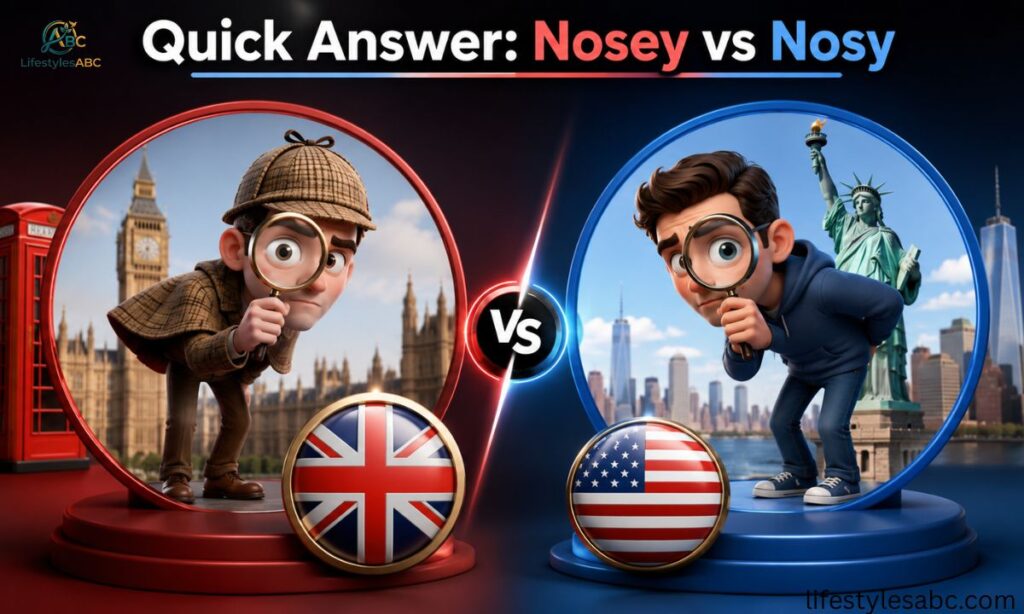
Both “nosey” and “nosy” are correct. They mean exactly the same thing. The only real difference is regional preference:
- Nosy → Standard in American English (preferred by Merriam-Webster and most US style guides)
- Nosey → Common in British English (accepted by Oxford and Cambridge dictionaries)
When in doubt, go with nosy; it’s the most universally recognized spelling in formal and international writing.
Nosey or Nosy How Do You Spell Nosy?
Both spellings are listed in major dictionaries. Merriam-Webster lists nosy as the primary entry, while the Oxford English Dictionary recognizes nosey as a valid British variant. The “e” in “nosey” follows a pattern found in British English, which historically retained extra vowels in words like colour and honour. American English simplified many of these, dropping the extra letter and landing on the cleaner “nosy.”
Memory trick: Think of the word nose, one nose, one “e.” Since nosy describes someone who sticks their nose into other people’s business, the shorter spelling (nosy) mirrors that simplicity.
Simple Origin and Background
The word traces back to the Old English nosu (“nose”), combined with the common adjective suffix -y, meaning “characterized by.” Early uses of nosy/nosey date to around 1610, when it simply meant “having a prominent nose.” The meaning shifted toward “prying” or “inquisitive” by the 1880s, right around the time the colorful British phrase “nosey parker” (meaning a busybody) began appearing in print. Both spellings coexisted from the very beginning, which is exactly why the confusion has persisted ever since.
Clear Explanation of the Difference: Nosey vs Nosy
There is no difference in meaning between nosey and nosy. Both describe a person who:
- Asks overly personal or intrusive questions
- Pries into matters that don’t concern them
- Shows excessive curiosity about others’ private lives
- Eavesdrops, snoops, or meddles uninvited
The distinction is purely about spelling and geography, not definition or tone. That said, switching between the two spellings within the same document looks inconsistent and unprofessional. Pick one and stick with it.
Comparison Table: Nosey vs Nosy
| Feature | Nosy | Nosey |
| Meaning | Overly curious, prying | Overly curious, prying |
| Spelling standard | American English | British English |
| Dictionary (primary) | Merriam-Webster ✅ | Oxford / Cambridge ✅ |
| Formality | Preferred in formal writing | More casual / informal feel |
| Comparative form | Nosier | Nosier |
| Superlative form | Nosiest | Nosiest |
| Pronunciation | /ˈnoʊ.zi/ | /ˈnoʊ.zi/ |
| International use | Widely accepted globally | Mainly UK, Australia, Commonwealth |
Note: Regardless of whether you use nosy or nosey as the base word, the comparative and superlative forms are always nosier and nosiest, never “noseyer” or “noseyest.”
Which One Should You Use and When?
Use “nosy” when:
- Writing for an American audience
- Submitting formal documents, essays, or academic work
- Writing for international or global readers
- Following AP Style or Chicago Manual of Style
- Unsure which version fits your audience
Use “nosey” when:
- Writing casually for a British or Commonwealth audience
- Creating informal content like social media posts or text messages
- Writing fiction set in a British context
- Following British editorial style guidelines
Bottom line: If you’re unsure, always default to nosy. It’s the safer, more widely accepted spelling in professional and international contexts.
Common Mistakes People Make: Nosey vs Nosy
Even careful writers stumble here. Here are the most frequent errors to avoid:
- Mixing both spellings in one document picks one and is consistent throughout.
- Using “nosey” in formal US writing it can appear careless or incorrect to American readers.
- Writing “noseyer” or “noseyest” these forms don’t exist. Always use nosier and nosiest.
- Confusing “nosy” with “noisy” is a completely different word. Noisy means loud; nosy means prying.
- Over-relying on autocorrect not all platforms flag “nosey” as incorrect, so always proofread manually.
Everyday Real-Life Examples of Nosey vs Nosy
Here are natural, in-context sentences using both spellings:
Using “nosy”:
- “My coworker is so nosy she always asks about my salary.”
- “Don’t be nosy; that’s a private conversation.”
- “The nosiest neighbor on the block installed cameras facing our yard.”
Using “nosey”:
- “That reporter was a bit nosey, asking questions that were clearly off-limits.”
- “She’s always been nosey about what other people earn.”
- “Stop being so nosey and mind your own business!”
Both sets of sentences are grammatically correct. The only difference is the regional flavor each carries.
Short Learning Section for Students and Beginners
New to this debate? Here’s everything you need in five simple points:
- Same meaning nosy and nosey, both describe someone who pries into others’ business.
- Different regions nosy = American English; nosey = British English.
- One is more common, nosy appears in more texts globally and is the safer choice.
- Comparative forms don’t change, always write nosier and nosiest, regardless of your base spelling.
- Consistency matters whichever you choose, use it throughout your entire document.
Quick quiz: Fill in the blank: “Our neighbor is so she always peeks through the fence.” ✅ Answer: Either nosy or nosey is correct. If you’re writing for an American audience, go with nosy.
Frequently Asked Questions
Is “nosey” wrong to use?
No nosey is a legitimate spelling, especially in British English, though nosy is more universally accepted in formal writing.
Which spelling do most dictionaries prefer?
Merriam-Webster lists nosy as the primary entry; Oxford and Cambridge accept both but note nosey as a British variant.
Can I use “nosey” in a formal essay?
If writing for a US audience or following American style guides, stick with nosy to appear professional.
Do nosy and nosey sound different when spoken?
No both are pronounced identically: /ˈnoʊ.zi/. The difference is purely in spelling.
What’s the correct comparative form nosier or noseyer?
Always nosier and nosiest the forms “noseyer” and “noseyest” are grammatically incorrect.
Is “nosy parker” spelled with a y or ey?
Both nosy parker and nosey parker are used, though the British-origin phrase more commonly appears as nosey parker.
Which spelling should non-native English speakers learn?
Learn nosy; it’s the modern standard, accepted globally, and less likely to cause confusion in any context.
Conclusion
The nosey vs nosy debate comes down to one simple fact: they mean the same thing, just spelled differently depending on where you are in the world. American English settled on nosy; British English kept nosey. Both are correct, both appear in respected dictionaries, and both clearly describe that person who can’t help sticking their nose into everyone else’s business.
For most writers, especially those aiming for global reach or formal tone, nosy is the smart, safe default. It’s shorter, more widely recognized, and listed as the primary form in Merriam-Webster. Choose your spelling, stay consistent, and you’ll always get it right.

Brook is the creator and author behind Healthy Leeks, a platform focused on grammar, writing skills, and English language learning. Passionate about clear communication and effective writing, Brook shares practical grammar tips, easy-to-follow language guides, and educational content to help readers improve their English with confidence.