
You typed “bagpack” into a search bar and nothing looked quite right. Or maybe your teacher circled it in red. Either way, you’re not alone. This is one of the most searched spelling questions in English today. So let’s settle it once and for all.
The correct word is: backpack. “Bagpack” is not a recognized word in any major English dictionary.
By the end of this guide, you’ll know the backpack definition, where the word comes from, why “bagpack” keeps spreading, and how to always get it right whether you’re a student, a writer, or just someone who Googled it out of curiosity.
Backpack Definition and Meaning
Before diving into the bagpack vs backpack debate, it helps to understand what the word actually means.
According to Merriam-Webster, a backpack is “a pack that usually has two shoulder straps and is carried on the back.” It can be a large canvas or nylon pack used for hiking and camping, or a smaller everyday bag used for carrying books, a laptop, or personal items.
Cambridge Dictionary defines it similarly: “a large bag used to carry things on your back.”
In everyday language, a backpack is:
- A bag worn on both shoulders with two straps
- Used by students, hikers, travelers, and commuters
- Available in sizes ranging from small daypacks to large expedition packs
- Also known as a rucksack, knapsack, schoolbag, bookbag, or haversack
The word functions as both a noun (“She packed her backpack”) and a verb (“We backpacked through Europe”).
Where the Word “Backpack” Comes From
Understanding the origin of “backpack” makes it much easier to spell and remember correctly.
According to Etymonline, the word “backpack” first appeared in English around 1904, formed by combining two simple words:
- Back from Old English bæc, meaning the rear part of the body
- Pack from Middle Dutch pak, meaning a bundle or load
Put them together: a back + pack = a pack carried on the back. It’s as literal as English gets.
The Oxford English Dictionary traces its earliest printed evidence to 1896 in an Iowa newspaper. By 1916, it was already being used as a verb meaning “to hike while carrying supplies in a backpack.”
Before “backpack” became the standard term, English speakers used older words borrowed from German rucksack (from Rücken, meaning “back”) and knapsack (in use since 1603). The word “backpack” gradually replaced them in American English and eventually spread worldwide.
Bag Pack vs Backpack
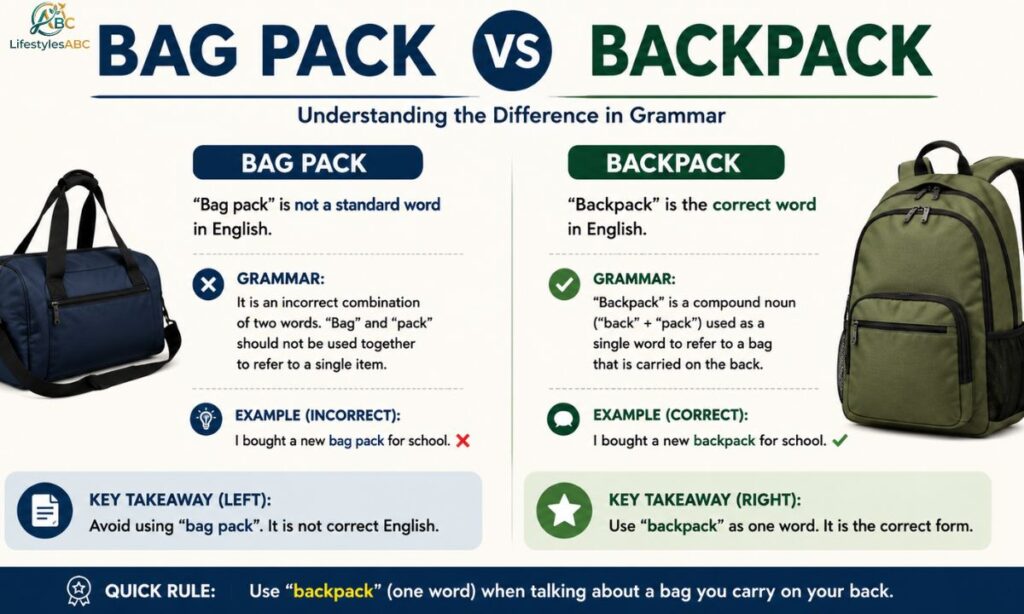
Now for the core question: what’s the difference between a bag pack and backpack?
| Term | Status | Recognized in Dictionaries? | Usage |
| backpack | ✅ Correct | Yes Merriam-Webster, Cambridge, Oxford | Standard English, all contexts |
| bagpack | ❌ Misspelling | No | Informal, non-standard, incorrect |
| bag pack | ❌ Incorrect (two words) | No | Not standard |
| back pack | ⚠️ Outdated | Rarely | Hyphenated form (back-pack) was used early 1900s |
The bottom line: only backpack (one word, no space) is correct in modern English.
The Difference Between Bagpack and Backpack
People sometimes ask this as if the two words have different meanings. They don’t. Both are intended to describe the same object. The only difference is that one is correct and one is a mistake.
Here’s the simplest breakdown:
- Backpack = correct spelling, found in every dictionary, used in schools, professional writing, and published media
- Bagpack = a spelling error that has spread through informal writing, social media, and non-native English use
Neither is a regional variation. American English, British English, Canadian English, and Australian English all use backpacks. There is no country or dialect where “bagpack” is the accepted form.
Why Do People Say “Bagpack”?
This is a fair question and the answer makes a lot of sense once you think about it.
The word “bag” is familiar. Everyone knows what a bag is. When people look at a backpack, they naturally think: it’s a bag, and you carry it on your pack (back). So the brain rewrites it as “bag-pack.”
Several factors fuel this mix-up:
- Sound association The first syllable of “backpack” sounds similar to “bag” when spoken quickly
- Non-native speakers Many languages structure compound words differently, making “bag + pack” feel more intuitive than “back + pack”
- Fast typing Autocorrect doesn’t always catch it, so the error spreads in texts and social media posts
- Online repetition Once a misspelling appears in product listings, blogs, or forums, people assume it’s valid
None of these reasons make “bagpack” correct, but they explain why it’s so persistent.
Is “Backpack” One Word or Two Words?
Short answer: one word.
| Form | Correct? |
| backpack | ✅ Yes |
| back pack | ❌ No |
| back-pack | ⚠️ Outdated hyphenated form, rarely seen today |
| bagpack | ❌ No |
In early 20th-century writing, you might occasionally see “back-pack” with a hyphen. That’s because compound words in English often start hyphenated and eventually merge into one word as they become more common. Today, backpack as a single unhyphenated word is universally standard.
Which Word Should You Use?
Always use a backpack. No exceptions.
- Writing an essay or school assignment? → backpack
- Posting on social media? → backpack
- Shopping online? → backpack
- Writing a product description or blog post? → backpack
If you’re writing for a professional or academic audience, using “bagpack” will immediately flag your writing as containing a spelling error. Spell-checkers in Microsoft Word and Google Docs will typically underline it.
Common Mistakes People Make
Here are the most frequent errors and how to fix them:
| Incorrect ❌ | Correct ✅ |
| I left my bagpack in the classroom. | I left my backpack in the classroom. |
| This is a great travel bagpack. | This is a great travel backpack. |
| Buy a school bagpack online. | Buy a school backpack online. |
| She packed her bag pack. | She packed her backpack. |
| I bought a new back pack. | I bought a new backpack. |
One more common mistake: thinking that “backpack” and “rucksack” mean different things in everyday use. In practice, interchangeable rucksacks are simply more common in British and European English.
Everyday Real-Life Examples
Here’s how to use backpack correctly in real sentences:
- The students lined up with their backpacks on.
- She stuffed her backpack with books, a water bottle, and her laptop.
- We decided to backpack through Southeast Asia for three months.
- His backpack was so heavy that he could barely lift it.
- The hiking backpack had a built-in frame to distribute the weight.
- Airport security asked passengers to place their backpacks on the conveyor belt.
Notice that in every case, “backpack” works perfectly and “bagpack” would stick out immediately as an error.
Learning Tip for Students and Beginners
Struggling to remember the correct spelling? Here’s a trick that never fails:
Think: “I carry it on my BACK. So it’s a BACK-pack.”
The word tells you exactly how you wear it. The back is where it sits. A pack is what you carry. There’s no “bag” in the picture because a backpack isn’t just any bag. It’s specifically designed to go on your back.
You can also associate it with the verb: to backpack (travel with a backpack). You’d never say “I went bagpacking through Europe” and that should make the correct form crystal clear.
Another useful memory anchor: every major dictionary in the world Merriam-Webster, Oxford, Cambridge lists “backpack.” None of them list “bagpack.” When in doubt, look it up.
Frequently Asked Questions
Is “bagpack” a real word?
No. “Bagpack” is not found in any major dictionary. It is a misspelling of “backpack.”
What is the correct spelling bagpack or backpack?
The correct spelling is backpack (one word, no space or hyphen).
Is backpack one word or two words?
Backpack is one word. “Back pack” (two words) and “back-pack” (hyphenated) are not standard in modern English.
What does backpack mean?
A backpack is a bag with two shoulder straps that is carried on a person’s back, used for school, travel, hiking, and daily activities.
Where did the word backpack come from?
It combines “back” (Old English bæc) and “pack” (Middle Dutch pak). It first appeared in print around 1896–1904 in American English.
Is a rucksack the same as a backpack?
Yes, they refer to the same item. “Rucksack” is more common in British and German-influenced English; “backpack” is the standard term in American and global English.
Can backpack be used as a verb?
Yes. “To backpack” means to travel or hike while carrying a backpack. Example: We backpacked through the mountains.
Conclusion
The answer is simple: backpack is correct. Bagpack is not a word.
Every major dictionary Merriam-Webster, Cambridge, Oxford agrees. No regional dialect, no style guide, and no English teacher will ever tell you to write “bagpack.” It’s a misspelling that has spread through the internet and informal writing, but that doesn’t give it legitimacy.
The word backpack comes directly from “back” + “pack” a logical, literal compound that’s been in standard use since the early 1900s. It works as a noun and a verb. It’s understood everywhere in the English-speaking world.
So the next time you reach for your bag before school, work, or a weekend hike you’ll know exactly what to call it.

Brook is the creator and author behind Healthy Leeks, a platform focused on grammar, writing skills, and English language learning. Passionate about clear communication and effective writing, Brook shares practical grammar tips, easy-to-follow language guides, and educational content to help readers improve their English with confidence.