
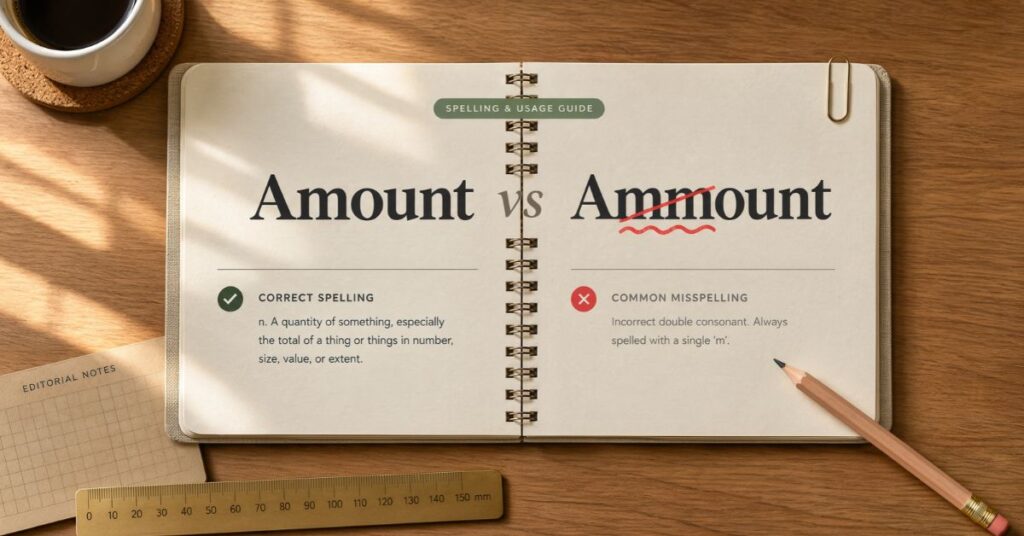
Have you ever been confused about whether to write amount or ammount? This spelling confusion is common because the word may sound like it contains two m letters. However, only one spelling is correct in standard English.
Amount is the correct spelling, while ammount is an incorrect variation that should be avoided in formal and informal writing. The word amount refers to the quantity, total, or value of something and is frequently used with uncountable nouns such as money, time, water, and information.
Quick Answer
- Amount: Correct spelling.
- Ammount: Incorrect spelling.
- Meaning: Amount refers to the quantity, total, or value of something.
- Spelling Rule: Always write amount with one m.
What Does Amount Mean?
Amount is a noun that refers to the quantity, total, or value of something. It is commonly used with uncountable nouns, including money, time, water, information, effort, and energy.
Amount can also function as a verb meaning to add up to a particular total or to have a specific value.
Examples of Amount
- The amount of money in my account has increased.
- We need a small amount of water.
- She spent a considerable amount of time studying.
- The amount of information was overwhelming.
- He received a significant amount of support.
- The expenses amount to $500.
These examples demonstrate how amount is used naturally in everyday English and formal writing.
What Does Ammount Mean?
Ammount is not a standard English word. It is simply a common spelling mistake caused by accidentally doubling the letter m.
Although some people use ammount in informal messages or online searches, it is not accepted as the correct spelling in standard English.
Incorrect and Correct Examples
Incorrect: The ammount of money is too high.
Correct: The amount of money is too high.
Incorrect: Please enter the total ammount.
Correct: Please enter the total amount.
Incorrect: A large ammount of money was spent.
Correct: A large amount of money was spent.
Remember that amount always contains one m.
Amount vs Ammount: Comparison Table
| Feature | Amount | Ammount |
|---|---|---|
| Correct spelling | Yes | No |
| Standard English word | Yes | No |
| Meaning | Quantity or total | No standard meaning |
| Letter m | One | Two |
| American English | Correct | Incorrect |
| British English | Correct | Incorrect |
| Formal writing | Accepted | Avoid |
Why Is Amount Correct?
The standard English spelling is amount, with only one m. The word entered English through French and ultimately comes from Latin roots associated with counting or totaling.
There is no spelling rule requiring an additional m.
The easiest way to remember the spelling is:
A-M-O-U-N-T
Not:
A-M-M-O-U-N-T
Amount has one m in American English, British English, and other standard English varieties.
Amount vs Number: What’s the Difference?
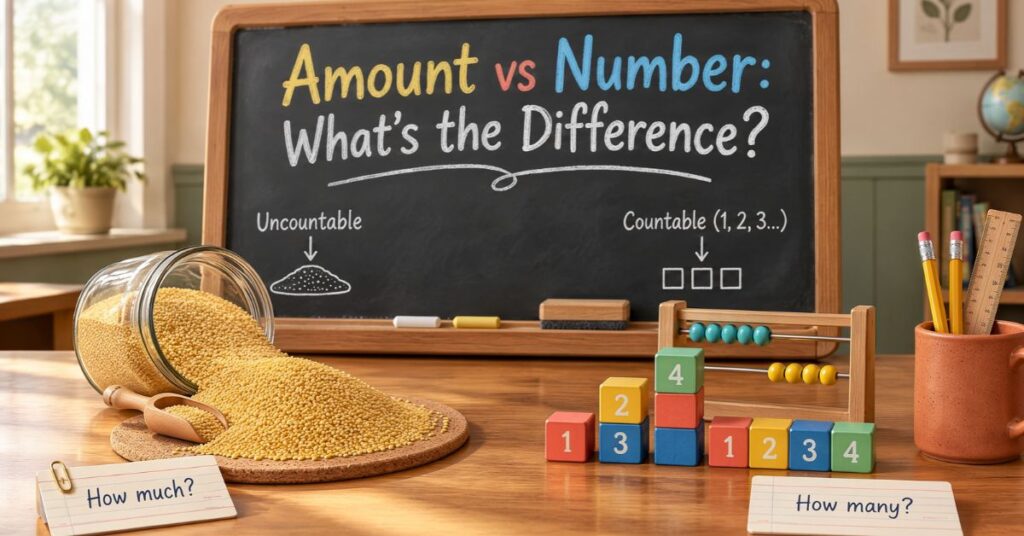
One important grammar distinction is knowing when to use amount and when to use number.
Use Amount With Uncountable Nouns
Amount is generally used with things that cannot be counted individually.
Examples:
- An amount of money
- An amount of water
- An amount of time
- An amount of information
- An amount of energy
- An amount of effort
Use Number With Countable Nouns
Number is used with things that can be counted individually.
Examples:
- A number of students
- A number of books
- A number of people
- A number of cars
- A number of employees
Amount vs Number Examples
- A large amount of money was donated.
- A large number of people attended.
- A considerable amount of time was required.
- A considerable number of students participated.
In formal standard English, using amount with plural countable nouns is generally avoided. Choosing the correct word makes your writing more accurate and professional.
Common Uses of Amount in Everyday English
Amount appears frequently in conversations, academic writing, financial documents, business communication, and everyday expressions.
Amount of Money
- What amount should I pay?
- The total amount is $200.
- I saved a considerable amount of money.
- The amount of money required depends on the project.
Amount of Time
- A considerable amount of time was required.
- I spend a small amount of time exercising.
- She dedicated a large amount of time to studying.
Amount of Information
- The report contains a large amount of information.
- We received a considerable amount of information.
- The amount of information available was impressive.
Amount of Work
- She completed a significant amount of work.
- The project requires a considerable amount of effort.
- I have an enormous amount of work to finish.
Amount vs Quantity: Understanding the Difference
Amount and quantity are closely related words, but their usage can differ depending on the context.
Amount generally refers to the total or quantity of something, especially uncountable substances, resources, or abstract concepts.
Quantity is a broader term describing how much of something exists or is available. It can be used with both countable and uncountable items, particularly in technical, commercial, and measurement contexts.
Examples
- A large amount of money was invested.
- The quantity of water was measured carefully.
- We purchased a quantity of books.
- The amount of effort required was substantial.
Both amount and quantity can be correct, but amount is often the more natural choice in everyday English.
Easy Memory Trick: How to Spell Amount Correctly
If you frequently confuse amount and ammount, try this simple spelling trick.
Think:
AMOUNT = A + MOUNT
The word mount contains only one m, so amount also contains only one m.
Remember:
- A + MOUNT = AMOUNT
- A + MMOUNT = Incorrect
This simple memory trick can help you avoid spelling mistakes in emails, essays, assignments, and professional documents.
American vs British English: Amount or Ammount?
There is no spelling difference between American and British English when it comes to amount.
| American English | British English |
|---|---|
| Amount | Amount |
| Ammount | Incorrect |
Both American and British dictionaries recognize amount as the correct spelling.
Whether you are writing for a U.S. audience, a British audience, or an international audience, always use amount.
Common Spelling Mistakes to Avoid
Here are some frequently encountered mistakes involving amount.
| Incorrect | Correct |
|---|---|
| Ammount | Amount |
| Total ammount | Total amount |
| Large ammount | Large amount |
| Small ammount | Small amount |
| Amount of peoples | Number of people |
| Amount of books | Number of books |
Correct spelling and grammar help make your writing easier to understand and more credible.
Related Words and Synonyms for Amount
Depending on the context, several words can be used as synonyms for amount.
- Quantity
- Total
- Sum
- Volume
- Measure
- Number
- Value
- Extent
- Figure
- Aggregate
Common Expressions With Amount
- Large amount
- Small amount
- Total amount
- Amount of money
- Amount of time
- Amount of information
- Amount of effort
- Amount of work
Choosing an appropriate synonym can make your writing more natural and prevent unnecessary repetition.
Expert Writing Tips for Using Amount Correctly
To improve your English spelling and grammar, remember these practical tips:
- Always spell amount with one m.
- Use amount primarily with uncountable nouns.
- Use number with countable plural nouns.
- Avoid ammount in formal and professional writing.
- Proofread financial documents, emails, and academic assignments.
- Use synonyms such as quantity, total, or sum when appropriate.
For example:
- Amount of money: Correct.
- Amount of time: Correct.
- Number of students: Correct.
- Number of books: Correct.
Using the correct spelling and grammatical construction makes your writing more precise and professional.
Frequently Asked Questions
Is amount correct?
Yes. Amount is the correct spelling in standard English. It refers to the quantity, total, or value of something.
Is ammount a real word?
No. Ammount is a common misspelling of amount and is not accepted as a standard English word.
How do you spell amount?
The correct spelling is A-M-O-U-N-T: amount.
Does amount have one or two m’s?
Amount has only one m. Writing two m’s is incorrect.
What is the difference between amount and number?
Amount is generally used with uncountable nouns, such as money, time, and water. Number is used with countable nouns, such as students, books, and cars.
Is amount spelled differently in British English?
No. Amount has the same spelling in American and British English.
What is a synonym for amount?
Common synonyms include quantity, total, sum, volume, measure, and value. The best synonym depends on the context.
How can I remember the correct spelling of amount?
Think of A + MOUNT = AMOUNT. Since mount contains one m, amount also contains one m.
Can amount be used as a verb?
Yes. Amount can function as a verb meaning to add up to a particular total or to have a specific value.
Example: The expenses amount to $500.
Is amount of people grammatically correct?
In formal standard English, number of people is generally preferred because people are countable.
Correct: A large number of people attended the event.
Summary
The correct spelling is amount, not ammount. Amount refers to the quantity, total, or value of something and is commonly used with uncountable nouns such as money, time, water, information, and effort.
Ammount is simply a spelling mistake and should be avoided in academic, professional, and everyday writing. The spelling remains amount in both American and British English.
To remember the correct spelling, use the simple trick A + MOUNT = AMOUNT. Additionally, remember the grammar distinction: use amount for uncountable nouns and number for countable nouns.
Mastering this small spelling difference can help you write more clearly, confidently, and professionally.

Abu Bakar is the admin of LifestyleABC.com with 3 years of experience in grammar and language content. He specializes in English grammar, synonyms, spelling, and word usage, creating clear and practical content to help readers improve their vocabulary and communication skills.