
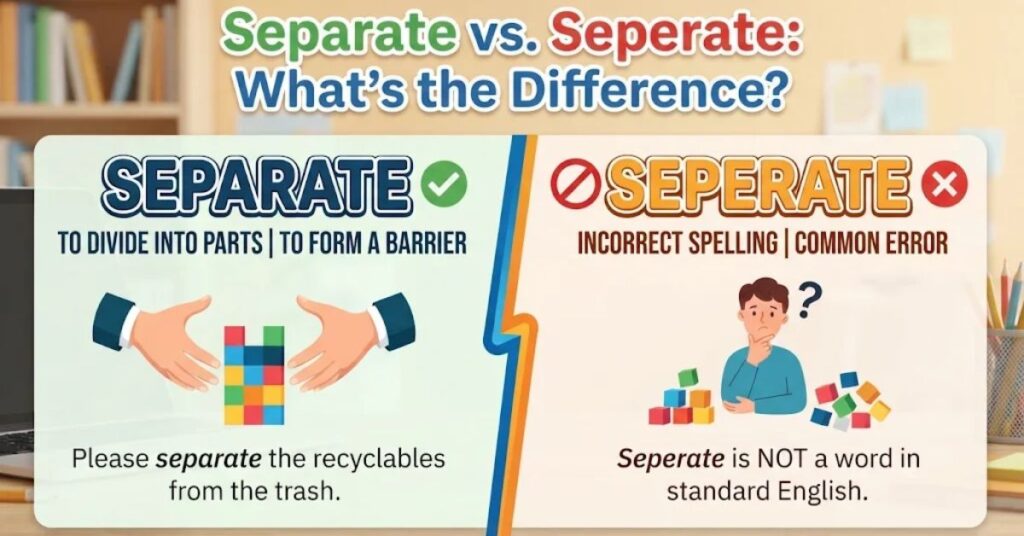
Have you ever typed a word, looked at it twice, and wondered whether you’ve spelled it correctly? The confusion between separate and seperate is surprisingly common. Even experienced writers, students, and professionals sometimes struggle with this small spelling difference. Both versions look similar, and their pronunciation makes the mistake even easier to understand. However, only one spelling follows standard English rules.
The correct spelling is separate, while seperate is a common spelling mistake. The easiest way to remember it is to focus on the letter A in the middle. This guide explains the difference, meaning, pronunciation, grammar, and everyday usage of both forms. You’ll also learn practical memory tricks, useful examples, and proofreading techniques that can help you avoid this mistake in future writing.
The Real Reason People Get Confused Between “Separate” and “Seperate”
English spelling doesn’t always follow pronunciation. That’s exactly why separate and seperate cause confusion. When people pronounce separate quickly, the middle vowel becomes less noticeable. It may sound like an E instead of an A.
As a result, writers often type the spelling that seems natural to their ears. Unfortunately, that creates the incorrect form seperate.
Several factors contribute to this common mistake:
- Pronunciation: The middle vowel sounds weak in everyday conversation.
- Typing habits: People sometimes write words without thinking about their spelling.
- Visual confusion: Both versions look almost identical.
- Learning by sound: Some English learners rely more on pronunciation than spelling patterns.
Words such as operate, generate, and decorate can also influence how people remember vowel patterns. However, separate has its own spelling.
The Correct Form Explained Clearly (Once and for All)
Let’s settle the confusion immediately. The correct English spelling is separate. The spelling seperate is incorrect in standard English.
The word separate generally describes dividing something or keeping different things apart. It can function as both a verb and an adjective.
| Word | Meaning | Example |
|---|---|---|
| Separate | Divide or split | Please separate the documents. |
| Separate | Not joined or connected | They have separate bedrooms. |
| Seperate | Incorrect spelling | Seperate is not the standard form. |
Understanding the Word Structure
Break the correct spelling into three parts:
Sep + a + rate = Separate
Notice the letter A in the middle. That’s the important detail.
For example:
- Please separate the clean clothes from the dirty ones.
- The students work in separate groups.
- Keep your personal and professional responsibilities separate.
Remembering this structure makes the correct spelling easier to recognize.
Where the Misspelling “Separate” Comes From
The incorrect spelling seperate doesn’t appear randomly. It develops from common pronunciation habits and the way people process unfamiliar spelling patterns.
When someone speaks quickly, unstressed vowels often become less noticeable. The middle A in separate may sound closer to a short, unclear vowel. Consequently, writers sometimes replace it with E.
This problem becomes more noticeable among English learners who haven’t memorized the spelling.
Common Reasons Behind the Mistake
| Reason | Explanation |
|---|---|
| Pronunciation influence | The middle vowel sounds unclear. |
| Fast typing | Writers overlook individual letters. |
| Visual confusion | Both versions look similar. |
| Repeated mistakes | Incorrect spelling becomes familiar. |
| Autocorrect habits | Writers depend too heavily on software. |
Even experienced professionals can make this error. A familiar-looking word doesn’t always have the correct spelling.
“Separate” as Different Parts of Speech
One interesting feature of separate is its ability to work as different parts of speech. Its grammatical role depends on how you use it in a sentence.
Understanding these roles helps you recognize the word in different contexts.
Separate as a Verb
As a verb, separate means to divide something into different parts or groups.
Examples:
- Please separate the important papers from the old ones.
- The teacher will separate the students into smaller groups.
- We should separate facts from personal opinions.
Separate as an Adjective
As an adjective, separate describes things that aren’t connected, combined, or joined.
Examples:
- They work in separate offices.
- Each student received a separate assignment.
- We booked separate hotel rooms.
Separate and Separation
The related noun is separation. It describes the act or condition of becoming apart.
For example:
Their separation surprised everyone.
The adverb form is separately, which means doing something independently or individually.
For example:
Please submit both documents separately.
Why “Seperate” Is Always Incorrect
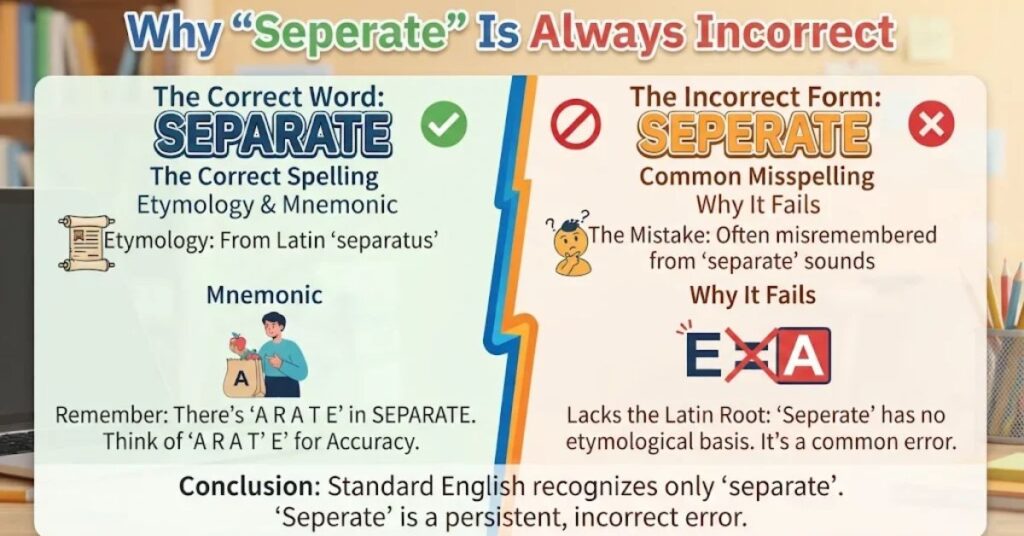
Here’s the rule worth remembering: seperate is not the standard English spelling.
Although people commonly use this version by mistake, it isn’t an accepted alternative to separate in standard American English.
You might encounter seperate in social media comments, informal messages, websites, or documents containing typing mistakes. However, seeing a spelling repeatedly doesn’t make it correct.
Why Does the Incorrect Version Keep Appearing?
There are several reasons:
- People copy spelling mistakes from online content.
- Fast typing increases the chances of missing letters.
- Some writers remember pronunciation rather than spelling.
- Incorrect versions become familiar through repeated exposure.
- Spellcheck tools don’t always catch every writing problem.
Can You Use Seperate in Formal Writing?
No. Avoid this spelling in academic assignments, business emails, professional reports, resumes, and other formal documents.
Always write separate when you mean to divide something or describe things that aren’t connected.
Smart Memory Techniques to Spell “Separate” Correctly
Memorizing separate becomes easier when you connect its spelling with a simple idea. You don’t need complicated grammar rules. A small memory trick can do the job.
1. Remember A Is for Apart
Think of this sentence:
Separate has an A because things are kept apart.
The connection between A and apart helps you remember the correct vowel.
2. Break the Word Into Smaller Parts
Instead of remembering the entire word at once, divide it into three sections:
- Sep
- A
- Rate
Now combine them: sep-a-rate.
This technique helps you focus on the middle letter.
3. Use a Visual Memory Trick
Imagine two objects moving away from each other. Place the letter A between them.
Whenever you think about separation, remember that central A.
4. Practice Through Writing
Repetition makes spelling more familiar. Write separate several times and use it in different sentences.
For example:
- Keep the files separate.
- Separate the ingredients carefully.
- We have separate responsibilities.
A little daily practice can prevent the same mistake from returning.
Pronunciation vs Spelling: The Real Conflict
Pronunciation and spelling don’t always match in English. Some words sound different from the way their letters might suggest.
Separate provides a useful example of this problem.
In careful speech, you may hear the word’s syllables more clearly. However, during normal conversation, speakers often reduce unstressed vowel sounds. The middle A becomes less noticeable.
Why Pronunciation Can Mislead You
Three things commonly happen during fast speech:
- Vowel reduction: Unstressed vowels lose their clear sound.
- Syllable compression: Speakers pronounce word parts quickly.
- Sound blending: Individual sounds become less distinct.
These changes explain why some people hear something resembling seperate.
Should You Spell Words According to Their Pronunciation?
Not always. English contains many words whose spelling doesn’t perfectly match their spoken form.
Therefore, it’s better to learn the standard spelling instead of relying entirely on what you hear.
When in doubt, remember the correct structure: sep-a-rate.
Practical Examples of “Separate” in Real Contexts
Examples make spelling rules easier to understand. Once you see separate in everyday situations, its meaning becomes much clearer.
Everyday Conversation
- Can you separate the white clothes from the colored ones?
- Let’s keep our shopping lists separate.
- Please separate these two boxes.
Academic Writing
- The research aims to separate facts from assumptions.
- Students should separate different topics into sections.
- Researchers separate variables to improve their analysis.
Workplace Communication
- Please keep urgent tasks separate from routine responsibilities.
- The manager assigned separate duties to each employee.
- We maintain separate records for every department.
Digital Communication
- Save the documents in separate folders.
- Keep personal and business emails separate.
- Please send the two reports as separate attachments.
Notice how the meaning remains consistent across these situations. Separate always communicates division, distinction, or independence.
Why Correct Spelling Matters in Real Communication
A small spelling mistake might seem harmless. However, written communication often creates someone’s first impression of your work.
Imagine sending a professional email containing several spelling errors. Even if your message makes sense, those mistakes can distract readers from its purpose.
First Impressions Matter
Correct spelling can demonstrate:
- Attention to detail
- Clear communication
- Professionalism
- Strong writing habits
- Careful proofreading
How Spelling Errors Affect Your Writing
Using seperate instead of separate doesn’t usually change what readers understand. Nevertheless, it can make your writing look less polished.
This matters particularly in:
- Job applications and resumes
- Academic assignments
- Business proposals
- Professional emails
- Website articles and blog posts
Correct spelling helps readers focus on your message rather than noticing avoidable mistakes.
Synonyms and Related Words for “Separate”
Learning synonyms gives you more ways to express the idea of separation. However, remember that different alternatives can carry slightly different meanings.
Here are some useful words:
| Synonym | Meaning | Example |
|---|---|---|
| Divide | Split into parts | Divide the students into teams. |
| Split | Break something into sections | Split the bill equally. |
| Detach | Remove something connected | Detach the cable carefully. |
| Isolate | Keep something apart | Isolate the damaged equipment. |
| Segregate | Separate into categories | Segregate the recyclable materials. |
| Disconnect | Break a connection | Disconnect the device. |
| Partition | Divide into sections | Partition the room into two areas. |
| Distinguish | Recognize differences | Distinguish facts from opinions. |
When Should You Use These Synonyms?
Choose a synonym according to the situation.
- Use divide when splitting something into parts.
- Use detach when removing a connected object.
- Use isolate when keeping something apart.
- Use disconnect when ending a connection.
- Use distinguish when identifying differences.
These alternatives improve vocabulary without changing your intended message.
Tools That Help You Avoid the “Seperate” Mistake
You don’t have to rely on memory alone. Modern writing tools can identify spelling mistakes and suggest corrections before you publish or send something.
Several useful options include:
Grammarly
Grammarly checks spelling, grammar, punctuation, and sentence clarity. It can highlight common spelling mistakes and recommend corrections.
Microsoft Editor
Microsoft Editor provides writing suggestions in Microsoft Word and supported applications. It helps identify spelling problems while you work.
Google Docs
Google Docs includes built-in spelling suggestions. When you type an incorrect word, it may underline the error and offer the correct spelling.
Browser Extensions
Some browser extensions check spelling while you write emails, online posts, and website content.
Why Human Proofreading Still Matters
Automated tools are helpful, but they aren’t perfect. They can miss contextual errors or overlook problems that require human judgment.
Before publishing important content, check your spelling manually. Pay particular attention to commonly confused words such as separate.
Commonly Confused English Words You Should Watch Next
Separate and seperate aren’t the only confusing English forms. English contains many similar-looking or similar-sounding words that create spelling and grammar problems.
Here are a few useful examples:
| Words | Difference |
|---|---|
| Apologize vs. Apologise | Both are correct regional spellings. Apologize is standard American English. |
| Heel vs. Heal | Heel refers to the foot; heal means to recover. |
| Formulae vs. Formulas | Both are accepted plural forms of formula. |
| Who vs. Whom | Who is a subject form; whom is an object form. |
| Parole vs. Parol | Parole commonly refers to conditional release; parol is a legal term. |
| Stank vs. Stunk | Both relate to stink but serve different grammatical roles. |
| Heard vs. Herd | Heard relates to listening; herd refers to a group of animals. |
Learning these distinctions can improve your English vocabulary and make everyday writing more accurate.
Quick Practice Section to Lock the Rule in Memory
Ready to test your spelling knowledge? Try these short exercises before checking the answers.
Fill in the Blanks
Choose the correct spelling to complete each sentence.
- Please ______ the documents into two groups.
- They have ______ bedrooms.
- We should keep personal and professional matters ______.
- The teacher asked us to ______ the students.
Spot the Spelling Mistake
Read these sentences and identify the incorrect word.
- She decided to seperate the files.
- Please keep the ingredients separate.
- The students work in seperate classrooms.
- We need to separate these documents.
Correct Answers
- Separate
- Separate
- Separate
- Separate
The first and third sentences contain spelling mistakes. Replace seperate with separate.
Remember This Simple Rule
Whenever you write this word, check its middle vowel.
Correct: Sep-a-rate
Incorrect: Sep-e-rate
A few seconds of attention can help you avoid this common spelling mistake.
Conclusion: Separate vs. Seperate: What’s the Difference?
Understanding separate vs. seperate doesn’t require complicated grammar lessons. The main rule is simple: separate is the correct spelling, while seperate is a common mistake. Both versions may look similar, but only one belongs in standard English writing. Remember the letter A in the middle whenever you need to use this word. You can also practice its verb and adjective forms to become more confident with everyday usage.
Good spelling makes your messages easier to read and helps create a professional impression. Whether you’re writing an assignment, sending an email, or publishing a blog post, take a moment to check your words. Keep the simple phrase A is for Apart in mind. With regular practice, you’ll remember separate naturally and avoid the same spelling confusion in the future.
FAQs
1. Is separate or seperate the correct spelling?
Separate is the correct spelling in standard English. Seperate is a common spelling mistake and shouldn’t appear in formal writing.
2. Why do people spell separate as seperate?
People often confuse the middle vowel because its pronunciation becomes less noticeable during everyday conversation.
3. What does separate mean?
Separate means to divide things into different parts or describe objects, people, or places that aren’t connected.
4. Is separate a verb or an adjective?
Separate can function as both. As a verb, it means divide; as an adjective, it describes things that aren’t joined.
5. How can I remember the spelling of separate?
Remember A is for Apart. The middle letter A in separate can help you recall its correct spelling.
6. What is the difference between separate and separately?
Separate is a verb or adjective, while separately is an adverb describing something done individually or independently.

Abu Bakar is the admin of LifestyleABC.com with 3 years of experience in grammar and language content. He specializes in English grammar, synonyms, spelling, and word usage, creating clear and practical content to help readers improve their vocabulary and communication skills.