
Starting a new project often feels overwhelming when you do not know where to begin. Choosing the right environment configuration gives you a solid foundation so you can build smoothly without hitting constant technical roadblocks. Taking time to properly configure system settings early on saves hours of frustrating troubleshooting later. A structured initial arrangement keeps your workflow organized, allowing you to focus completely on creative problem solving and efficient execution.
Ever spent hours fixing unexpected errors just because you skipped the initial phase? That simple mistake ruins your productivity and momentum fast. A clean workspace preparation eliminates unnecessary friction, ensuring your development workflow runs smoothly from day one. Taking a few extra minutes to organize tools properly changes everything about your ultimate success.
Properly completing your set up ensures long-term stability and peak performance. Streamlining your user preferences and tool integrations helps create a seamless experience. Once your system foundation is ready, you can move forward with total confidence.
Setup or Set Up: Which One Is Correct?
Both forms are entirely correct in written English, but they serve completely different grammatical functions. Deciding which option to choose depends entirely on the part of speech required in your sentence. Using the wrong version does not just create a minor typo; it alters the fundamental grammatical structure of your thought.
When you combine the words into a single term, it functions exclusively as a noun or an adjective. Conversely, when you separate them into two distinct words, they act together as a phrasal verb. Understanding this core distinction prevents common writing mistakes and ensures your prose remains polished, professional, and clear.
What Does “Setup” Mean?
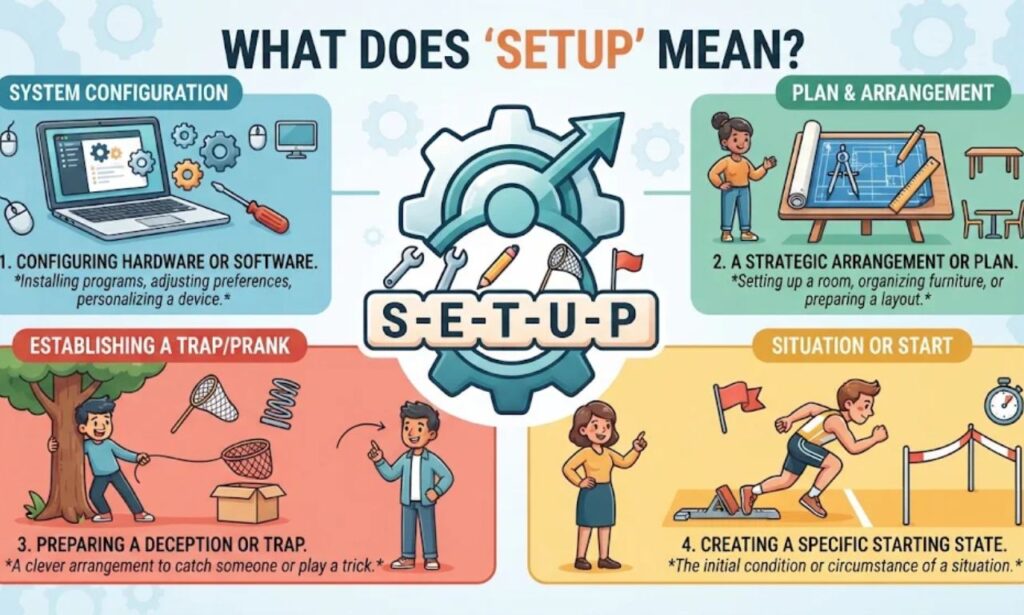
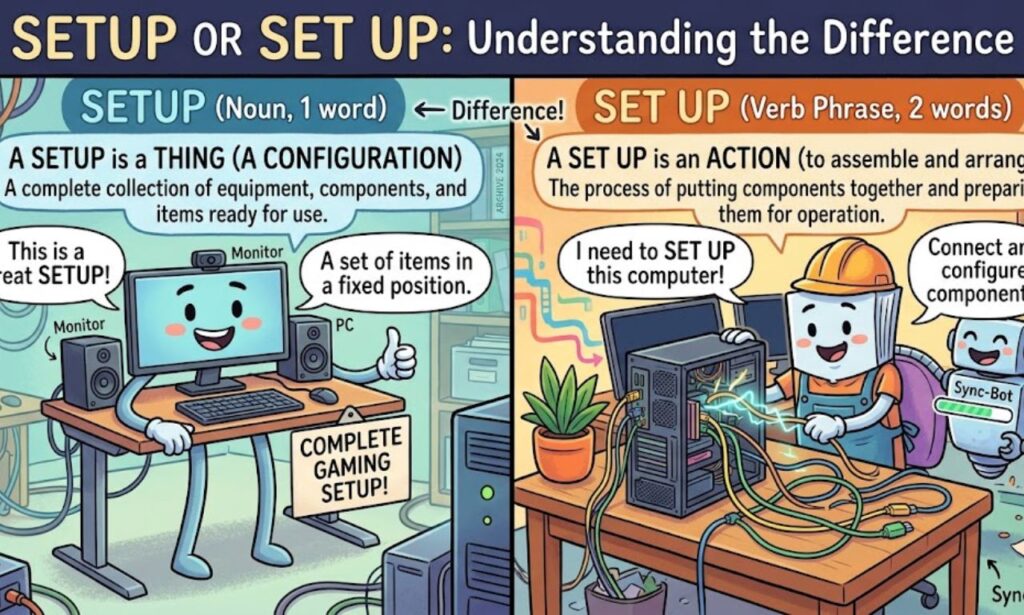
The single-word term functions as a noun or an modifier. As a noun, it refers to an arrangement, an organization, a physical layout, an apparatus, or a pre-planned situation. It describes the physical or organizational structure of something that has already been arranged.
As an adjective, it modifies a following noun to describe something related to initialization or preparation. For instance, in technical, operational, or mechanical settings, it describes the configuration process or the materials used during an initial assembly.
What Does “Set Up” Mean?
The two-word phrase is a phrasal verb that denotes action. It consists of the primary verb combined with a prepositional particle. Because it describes an active process, it indicates the act of assembling, establishing, arranging, organizing, or preparing something.
Whenever an action is taking place—whether you are assembling furniture, arranging a calendar meeting, configuring new computer software, or establishing a new business—the two-word action form is required. Because it is a verb phrase, it changes tense depending on sentence structure, turning into past tense or progressive forms.
Setup vs. Set Up: The Main Difference
The main difference between these two forms lies entirely in action versus state. The two-word phrase represents the dynamic action of creating or arranging something, whereas the single-word term represents the static result, object, or configuration that exists after the action is completed.
To quickly check your writing, try replacing the term with another action verb like “assemble” or a noun like “arrangement.” If an action verb fits naturally, use two words. If a noun fits, use the single word.
When to Use “Setup” as a Noun
You should use the single-word form whenever your sentence requires a noun to act as a subject, direct object, or object of a preposition. It frequently appears after articles such as “a,” “an,” or “the,” as well as possessive pronouns like “my,” “your,” or “their.”
It is widely used in technology, business, gaming, and everyday conversations to describe hardware arrangements, office spatial configurations, or structured plans. Identifying the article or pronoun preceding the word is the easiest way to confirm you need the noun form.
When to Use “Set Up” as a Verb
Use the two-word version whenever the subject of your sentence is performing an action. Because it operates as a phrasal verb, it can be split by direct objects in many sentence structures without losing its core meaning.
Furthermore, because it functions as a verb, it inflects for time. You will see it transform into conjugated variations depending on context, such as setting up for present continuous actions or set up for past tense events.
Easy Examples of “Setup” in Sentences
Examining practical everyday examples helps clarify how the noun operates naturally within various written contexts. Notice how the term refers to things, configurations, or arrangements in the following sentences:
- The IT technician optimized the new workstation setup for the incoming employee.
- She spent the entire weekend organizing her dual-monitor desk arrangement.
- The host prepared an elaborate table arrangement for the evening dinner party.
- Their current operational model is too complex for a small startup team.
Easy Examples of “Set Up” in Sentences
Reviewing verb usage clarifies how the two-word action phrase functions dynamically across modern sentences. Pay attention to the active processes described below:
- Please set up the conference room AV equipment before the executive meeting begins at nine.
- The logistics team will arrange the display booths early tomorrow morning.
- We need to establish a recurring video call to review weekly project milestones.
- He helped his grandparents configure their new wireless router over the weekend.
Setup or Set Up in Different Situations
Context dictates how these terms appear in specialized industries. In software engineering, hardware configuration, business administration, and legal environments, using the proper form ensures accurate technical documentation.
- Technology and Computing: Developers write code to set up databases, while end-users adjust their software installation options during initial launch.
- Business and Events: Event planners set up physical stages, whereas managers evaluate the final room arrangement before guests arrive.
- Legal and Law Enforcement: Investigators might uncover a fraudulent scheme or a criminal frame-job, which is referred to as a deceptive plot.
Is “Setup” One Word or Two Words?
It can be either one word or two words, depending entirely on context. It is not a matter of personal preference, modern style evolution, or arbitrary choice.
If you are using the term to name a concept, layout, or object, it must be written as a single word. If you are using it to express an action or process, it must be written as two separate words.
Common Mistakes With Setup and Set Up
The most common error occurs when writers default to the single-word version for all scenarios, mistakenly using it as a verb. This creates grammatical errors in business emails and technical manuals.
- Incorrect: We need to setup the new server before tomorrow.
- Correct: We need to set up the new server before tomorrow.
- Incorrect: The workstation set up looks clean and ergonomic.
- Correct: The workstation setup looks clean and ergonomic.
Another frequent mistake involves hyphenating the term. While hyphens were occasionally used in historical text, modern grammar standards overwhelmingly prefer either the solid single word for nouns or two separate words for verbs.
How to Remember the Difference Easily
A simple trick to remember the distinction is to look at the word “up.” If “up” can be replaced by “out,” “in,” or “off” while maintaining a logical verb structure (such as set out or set in), you need the two-word phrase.
Another reliable memory aid is the Space Rule: if you need a verb, leave a space between the words because actions require room to move. If you need a noun, close the space to join the concept together.
Setup vs. Set Up: Quick Comparison
Comparing the core characteristics of both forms side-by-side provides a clear structural reference for quick edits and proofreading.
| Feature | Single-Word Form | Two-Word Form |
| Part of Speech | Noun or Adjective | Phrasal Verb |
| Primary Function | Names a physical layout, arrangement, or state | Describes an active process or physical action |
| Sentence Placement | Follows articles (a, the) or possessive pronouns | Follows subjects or auxiliary verbs |
| Modifications | Pluralized by adding an -s (setups) | Inflects tense (setting up, set up) |
| Replacement Test | Replace with arrangement or configuration | Replace with assemble, configure, or establish |
The comparison table highlights how grammar determines spacing. Checking sentence syntax against these structural indicators ensures accurate word choice every time.
Setup or Set Up in American and British English
Grammatical rules governing these terms remain consistent across both American English and British English. Unlike spelling variations such as “color” versus “colour,” the distinction between the noun and verb forms is identical worldwide.
Whether you are writing for an American audience, a British publication, or an international business platform, the single-word form is universally recognized as the noun/adjective, and the two-word phrase is universally required for the verb. Following these standard rules ensures your writing remains clear, professional, and grammatically accurate across all global markets.
Frequently Asked Questions
What is the main grammatical difference when deciding between setup or set up?
The term setup or set up differs because the single-word form acts as a noun, while the two-word phrase functions as a verb.
Should I write setup or set up when referring to computer installation?
When referring to software configuration as an action, use the two-word verb form, but use the single-word noun for your overall setup or set up.
Can I use a hyphen instead of choosing setup or set up?
Hyphenating is outdated; modern grammar rules require choosing either the single-word noun or two-word verb when evaluating setup or set up for your sentences.
Which form of setup or set up is correct for business emails?
Use the two-word verb to arrange meetings and the single-word noun to describe an arrangement when deciding on setup or set up in emails.
Is there any difference between setup or set up in British and American English?
No regional difference exists; both dialects follow identical rules when selecting the single-word noun or two-word verb form for setup or set up.

Abu Bakar is the admin of LifestyleABC.com with 3 years of experience in grammar and language content. He specializes in English grammar, synonyms, spelling, and word usage, creating clear and practical content to help readers improve their vocabulary and communication skills.