
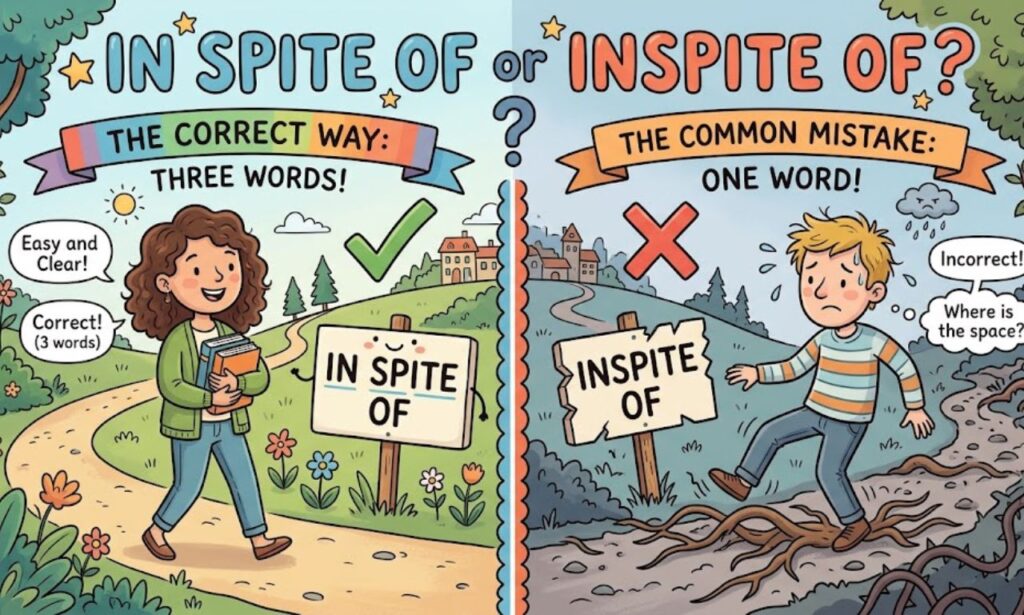
Many people struggle with written communication because grammar rules can feel confusing and overwhelming. Learning how to handle tricky phrase usage is a great way to improve your language skills and build confidence when writing. In spite of these everyday challenges, anyone can master sentence structure with a little bit of practice and clear guidance.
Have you ever paused mid-sentence, completely unsure if a prepositional phrase should be written as one word or two? You are definitely not alone. English spelling often creates unnecessary confusion for writers who just want to express their core ideas clearly without making embarrassing grammatical errors.
Understanding proper word choice makes a massive difference in your essay writing. Mastering syntax helps your text readability instantly, allowing your thoughts to flow naturally and cleanly.
In Spite of or Inspite Of: Which Is Correct?
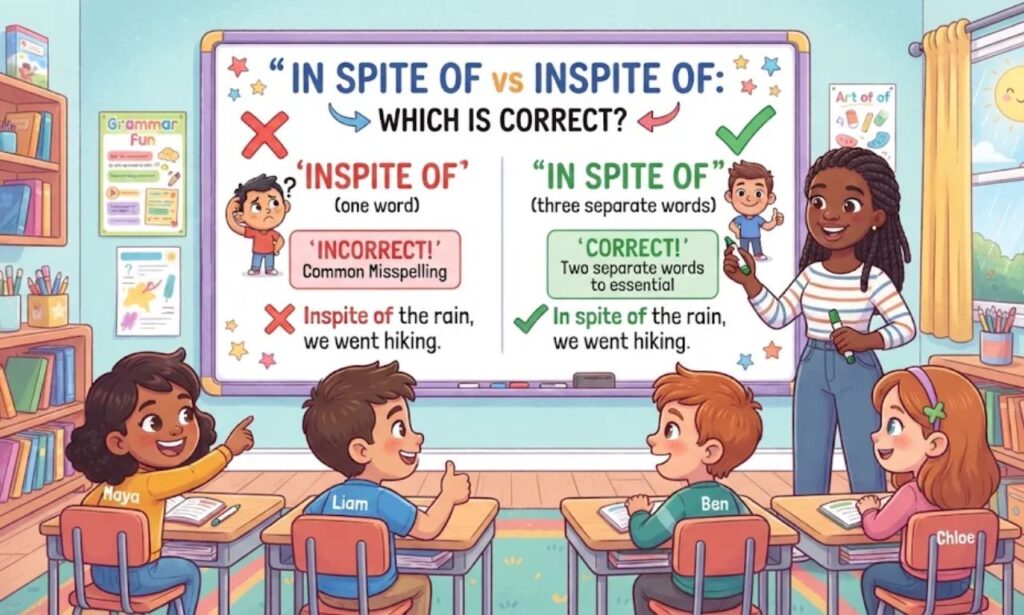
When choosing between in spite of or inspite of, the correct choice is always “in spite of” written as three distinct words. The single-word version “inspite” does not exist in the standard English language dictionary. Merging these terms into a single word is a frequent spelling mistake caused by how people pronounce the phrase in spoken English. Because speakers fluidly connect the sounds together, writers often mistakenly assume it is a compound word like “inside” or “into.”
Recognizing the proper three-word construction is critical for effective communication, academic writing, and digital publishing. Advanced search algorithms and natural language processing models evaluate digital content for syntax accuracy and linguistic quality. Consistently choosing the correct phrase in spite of or inspite of ensures your prose remains authoritative and clear. Using the incorrect non-word version creates unnecessary friction for human readers and can negatively affect automated readability scores evaluated by modern search engine crawlers.
What Does “In Spite Of” Mean?
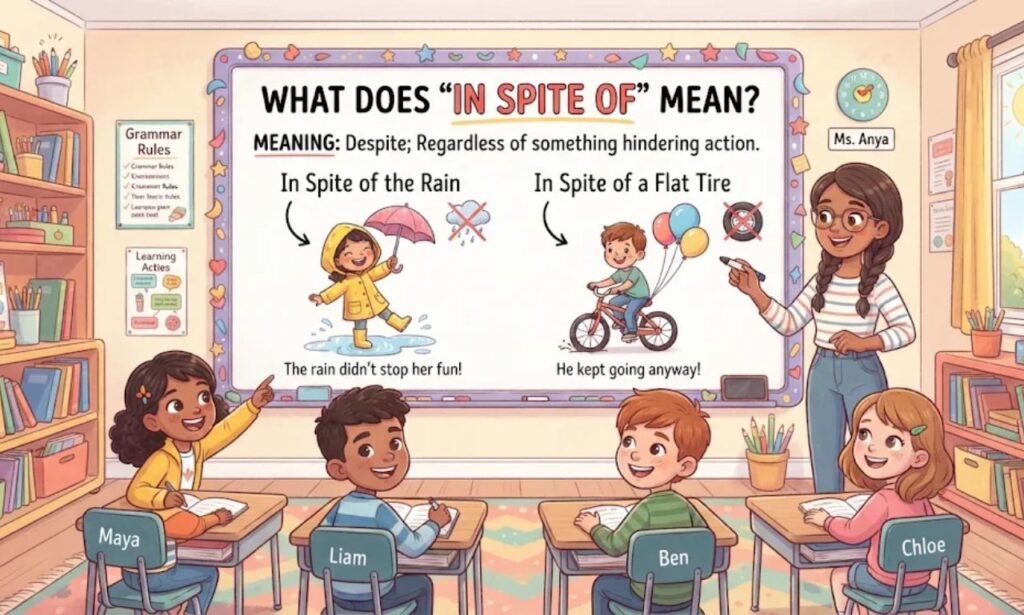
The phrase “in spite of” functions as a concessive prepositional phrase used to show contrast, unexpected results, or concession. It indicates that an action occurred, a situation exists, or a fact remains true regardless of an obstacle, difficulty, or opposing condition.
In everyday communication, “in spite of” signals to the reader that the main clause succeeded or happened even though something tried to stop it. For instance, in the statement “They arrived on time in spite of the heavy traffic,” the prepositional phrase highlights the contrast between the challenge (heavy traffic) and the successful outcome (arriving on time). Understanding this core function helps writers convey nuanced, contrasting ideas logically within a single sentence structure.
Why Is “Inspite Of” Incorrect?
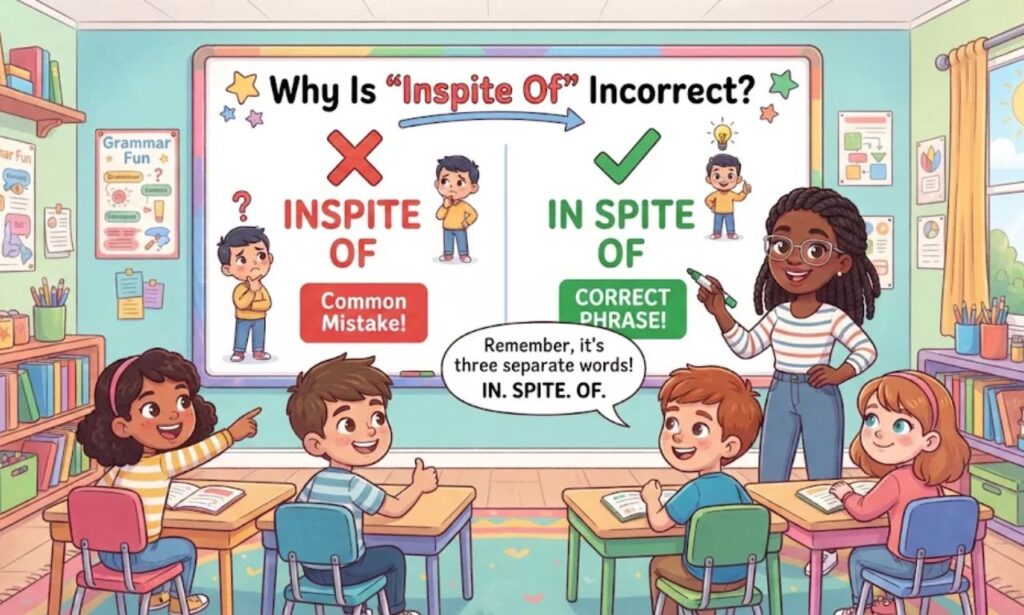
The form “inspite of” is entirely incorrect because “inspite” is a non-existent word in English orthography. The phrase “in spite of” is composed of three separate parts of speech: the preposition “in,” the noun “spite,” and the preposition “of.” Compounding “in” and “spite” into one term breaks established grammatical rules governing prepositional phrases.
Many writers fall into the trap of using “inspite” due to phonetic blurring during natural speech. Additionally, false analogies with other legitimized compound words—such as “instead,” “indeed,” or “inasmuch”—lead people to assume “inspite” is equally valid. However, language reference guides, style manuals, and lexicographers explicitly categorize “inspite” as an error. Removing this spelling mistake from your vocabulary immediately elevates the professional quality of your writing.
In Spite Of: Meaning and Definition
Etymologically, the word “spite” in “in spite of” traces back to the Middle English word atspit, derived from the Old French despit, meaning contempt or malice. Historically, to do something “in spite of” someone meant to do it directly to defy or show contempt for them.
Over centuries, the phrase evolved, softening its emotional charge. In contemporary English, “in spite of” serves a neutral grammatical function equivalent to “regardless of,” “notwithstanding,” or “even with.” It establishes a logical concession without implying actual malice or ill will.
| Phrase / Term | Grammatical Status | Meaning / Function |
| In spite of | Correct (3 words) | Concessive preposition meaning “regardless of” or “despite” |
| Inspite of | Incorrect (1 word error) | Invalid spelling mistake with no dictionary recognition |
| Despite | Correct (1 word) | Single-word concessive preposition with identical meaning |
| In spite | Incomplete phrase | Fragment lacking the necessary preposition “of” |
This table clarifies the structural differences between correct and incorrect variations. Keeping these distinctions in mind makes it much easier to select the right term when evaluating in spite of or inspite of during copyediting.
How to Use “In Spite Of” in a Sentence
Using “in spite of” properly requires placing it before a noun phrase, a pronoun, or a gerund phrase. It cannot be followed directly by a standard finite verb or a full independent clause without additional connecting words.
When placing “in spite of” at the beginning of a sentence, follow the introductory prepositional phrase with a comma to separate it from the main clause. If the phrase appears in the middle or at the end of a sentence, a comma is generally unnecessary unless required for stylistic clarity or complex sentence balance.
- Front Placement: In spite of [Obstacle], [Main Clause].
- End Placement: [Main Clause] in spite of [Obstacle].
- Clause Connector: In spite of the fact that [Subject + Verb], [Main Clause].
To connect “in spite of” to a full clause containing a subject and a verb, insert the connecting phrase “the fact that.” This turns the entire clause into a noun equivalent that satisfies the prepositional requirement.
In Spite Of Examples in Sentences
Examining practical examples shows how “in spite of” fits naturally into diverse sentence structures across different contexts:
- “The project was completed on budget in spite of severe material shortages.”
- “In spite of their initial differences, the two executives formed a successful business partnership.”
- “She managed to finish the marathon in spite of feeling completely exhausted.”
- “The outdoor concert continued in spite of the sudden downpour.”
In each example, the phrase sets up an obstacle while the main clause explains how the outcome occurred anyway.
In Spite Of With Nouns
The most frequent application of “in spite of” is directly before a simple noun or a expanded noun phrase. In this construction, the noun represents the circumstance or obstacle being overcome.
When framing options like in spite of or inspite of, remember that the three-word phrase acts as a bridge leading straight to the object noun. The noun can be concrete or abstract.
- Concrete Noun: “In spite of the rain, the children played outside all afternoon.”
- Abstract Noun: “He maintained a positive attitude in spite of his grief.”
- Complex Noun Phrase: “In spite of the unexpected technical difficulties during launch, the software performed reliably.”
In Spite Of With Pronouns
“In spite of” also pairs seamlessly with demonstrative, personal, or possessive pronouns. The pronoun stands in for a previously mentioned situation, event, or challenge.
- Personal Pronoun: “Everyone doubted his ability, but he succeeded in spite of them.”
- Demonstrative Pronoun: “The market crashed last week; in spite of that, investor confidence remains relatively high.”
- Possessive / Relative Pronoun: “She achieved her goals in spite of all that was stacked against her.”
Using pronouns after “in spite of” maintains narrative momentum without repeating complex noun phrases.
In Spite Of With Gerunds (-ing Words)
A gerund is a verb ending in “-ing” that functions grammatically as a noun. Because “in spite of” requires a noun object, gerunds fit perfectly after the preposition “of.”
This construction allows writers to describe an action directly without creating a clumsy, wordy clause. It streamlines your style and keeps your sentences dynamic.
- “In spite of working late every night, he never missed his morning workout.”
- “The team won the championship in spite of losing their starting quarterback in the first quarter.”
- “In spite of not having formal training, she designed an award-winning mobile application.”
Notice how the gerund phrase clearly describes the continuous or completed action functioning as the obstacle.
In Spite Of vs Despite: What’s the Difference?
A common question in English grammar is whether there is a difference between “in spite of” and “despite.” Grammatically and semantically, they mean the exact same thing and can be used interchangeably in nearly every situation.
The primary difference lies in their structure and formal tone. “Despite” is a single word, making it slightly more concise and popular in news headlines, executive summaries, and formal business reports. “In spite of” consists of three words and offers a smooth, balanced rhythm ideal for instructional guides, essays, and conversational prose.
- “In spite of the cold weather, they went hiking.” (3 words)
- “Despite the cold weather, they went hiking.” (1 word)
The most frequent mistake writers make when choosing between these options is combining them into the non-standard phrase “despite of.” Remember: “despite” never takes the preposition “of.” Use either “despite” alone or the full three-word phrase “in spite of.”
In Spite Of vs In Spite: Common Grammar Mistakes
Another error to avoid is dropping the final preposition “of” and leaving only “in spite.” On its own, “in spite” is an incomplete phrase fragment that fails to function as a preposition.
- Incorrect: “In spite the heavy rain, we went for a walk.”
- Correct: “In spite of the heavy rain, we went for a walk.”
The only instance where “spite” stands without “of” is when it operates as a standard noun or verb within an entirely different sentence construction (e.g., “She did it out of spite”). When expressing concession or contrast, all three words—in, spite, and of—are strictly required.
Common Mistakes With “In Spite Of”
Beyond spelling mistakes like “inspite,” several structural errors frequently disrupt sentence clarity. When proofreading your work, keep an eye out for these common grammatical traps:
- Using “Inspite” as a Single Word: Merging the terms into “inspite” or “inspite of” remains the most widespread mistake. Always maintain clear word boundaries: in + spite + of.
- Adding “Of” to “Despite”: Unintentionally creating the hybrid phrase “despite of” by mixing “despite” and “in spite of.”
- Following directly with a Subject + Verb Clause: Writing “In spite of he was tired…” instead of using a gerund (“In spite of being tired…”) or a connecting noun clause (“In spite of the fact that he was tired…”).
- Punctuating incorrectly with main clauses: Omitting the necessary comma when an “in spite of” phrase opens a complex sentence.
In Spite Of in Everyday English
In professional, casual, and academic contexts, “in spite of” remains a staple of natural English communication. It allows speakers and writers to frame resilience, contrast, and unexpected victories effectively.
Whether you are writing a marketing email, a technical white paper, or an academic essay, using clean concessive phrases makes your points more persuasive. If you ever find yourself hesitating over in spite of or inspite of while drafting content, remember that high-quality prose always respects the three-word standard.
How to Remember the Correct Spelling
To ensure you never use the incorrect form “inspite” again, rely on a few simple memory aids and editorial tricks:
- Count the Words: Remember the phrase “3 Words for 3 Syllables”—In (1) Spite (2) Of (3).
- The “In Spite Of” Space Check: If you can replace the phrase with the single word “Despite,” you need three separate words to balance the equation.
- Think of the Noun: Isolate the middle word “spite.” Since “spite” is a standalone noun, it needs space from the preposition “in” sitting in front of it.
- Automate Your Editor: Add “inspite” to your custom dictionary or spell-checker auto-correct rules so it automatically flags or corrects to “in spite of” as you type.
By applying these quick recall techniques, you can guarantee that every piece of content you produce maintains proper English spelling, clean syntax, and strong authority across all writing channels.

Abu Bakar is the admin of LifestyleABC.com with 3 years of experience in grammar and language content. He specializes in English grammar, synonyms, spelling, and word usage, creating clear and practical content to help readers improve their vocabulary and communication skills.