Starting a fresh website can feel like a total digital landscape mystery when you are trying to rank on Google. You draft great content, but without a clear SEO strategy, your pages simply sit invisible to potential readers. Improving your search engine visibility takes time, patience, and smart planning. Of course, mastering keyword optimization and understanding real user intent will help you attract organic traffic faster than relying on pure luck.
Ever wonder why some blogs get endless organic traffic while yours gets complete silence? The secret isn’t continuous posting; it is about delivering pure value that matches search queries. When you align your content with real search patterns, algorithm updates start working in your favor. Let us dive into the proven content optimization techniques that turn dynamic web page visits into lasting reader trust.
Building strong topical authority requires consistent quality across every single publication. By naturally weaving relevant semantic search terms into your writing, you help readers and search crawlers instantly grasp your core topic. Smart content creation always puts audience needs right at the very front.
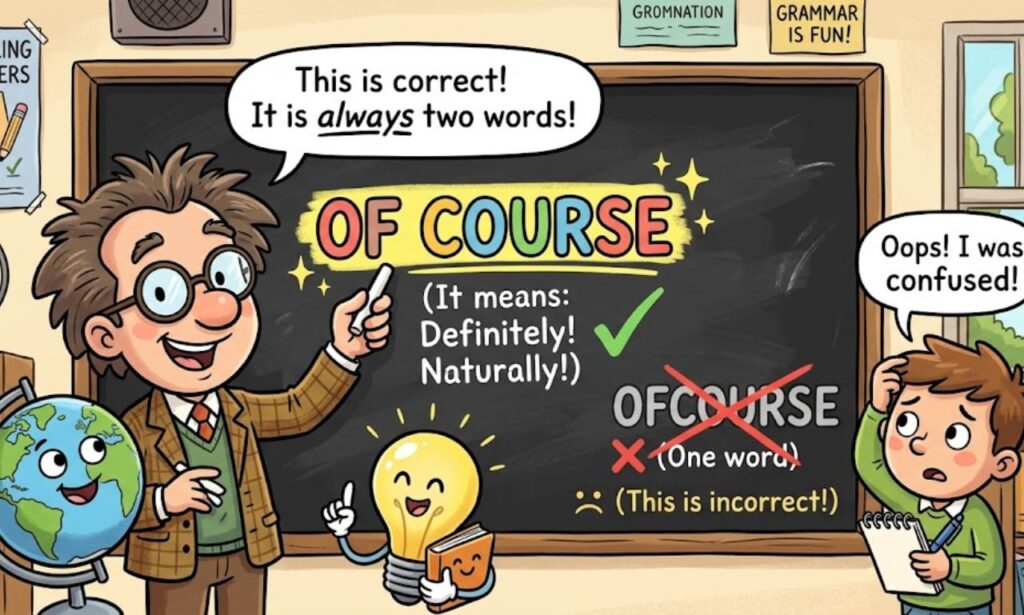
Of Course or Ofcourse: What Is the Correct Spelling?
The standard and grammatically correct spelling is always two separate words: “of course.” Writing “ofcourse” as a single combined word is considered a common spelling error in modern standard English. Understanding basic English grammar rules helps clarify why this phrase requires a space between the preposition “of” and the noun “course.”
When examining modern English usage, dictionaries like Merriam-Webster, Oxford English Dictionary, and Cambridge Dictionary consistently classify “of course” strictly as a multi-word prepositional phrase used adverbially. The single-word version “ofcourse” does not exist in formal lexicography.
While compounding words is a natural process in the evolution of the English language—turning phrase combinations like “into,” “cannot,” and “today” into single words—the phrase “of course” has maintained its traditional two-word structure for centuries. Writers evaluating of course or ofcourse should strictly use the two-word variant to maintain high standards of literacy and clarity in academic, professional, and creative contexts.
What Does “Of Course” Mean?
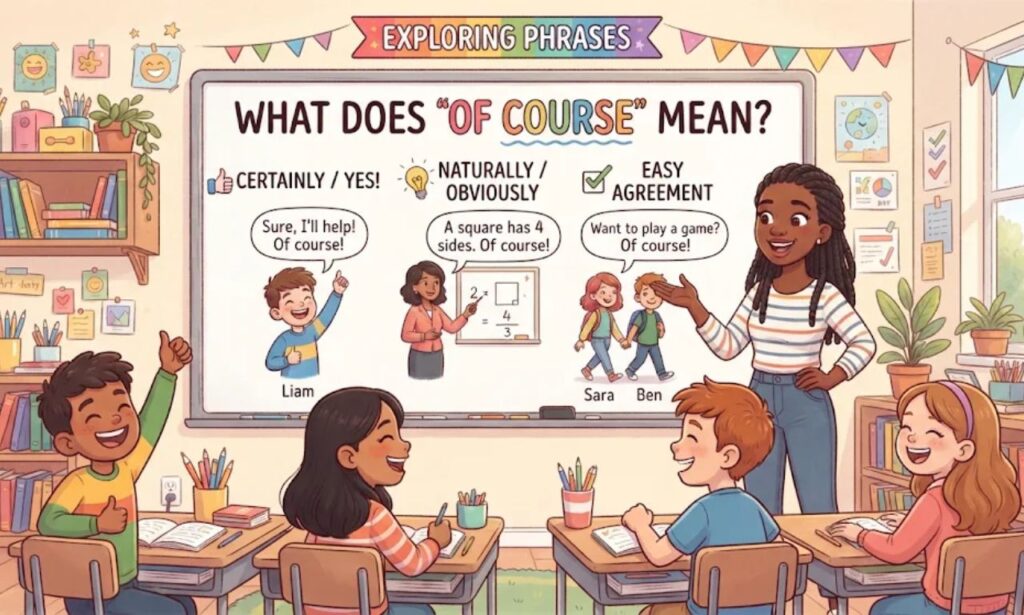
The phrase “of course” functions as an adverbial phrase meaning naturally, obviously, as expected, or without a doubt. It traces its origin to the historical concept of following a natural “course” or direction. When you say something happens “of course,” you are indicating that it follows the normal, expected path of events.
In everyday conversation, the expression serves multiple semantic functions depending on the context in which it appears:
- Expressing Agreement: Used as an enthusiastic synonym for “yes” or “certainly” when confirming a request or statement.
- Acknowledging the Obvious: Used to highlight a fact or outcome that requires no further explanation because it is self-evident.
- Granting Permission: Used as a polite response to a request, signaling that the action is completely acceptable.
- Conceding a Point: Used in arguments or explanations to acknowledge a reality before presenting a counterpoint.
Understanding these distinct meanings allows writers to apply the phrase precisely within context, ensuring clear logical flow across varied communication styles.
Why Is “Ofcourse” Incorrect?
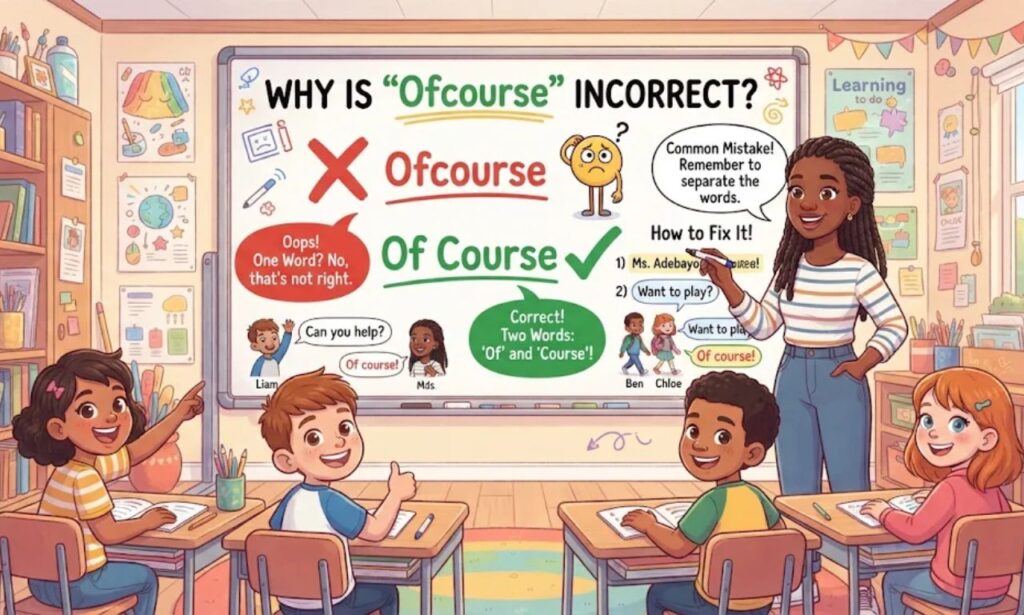
The form “ofcourse” is incorrect because it violates the structural rules governing prepositions and nouns in standard English syntax. The word “of” is a preposition that modifies or connects the following noun, “course.” Blending them into a single token creates an unrecognized compound that lacks formal grammatical standing.
Typographical errors often occur because spoken language naturally blends the sounds together into a single spoken cadence, known phonetically as liaison or connected speech. When people speak quickly, the space between “of” and “course” disappears verbally, leading many writers to incorrectly assume the phrase is written as a single word.
Furthermore, digital text processing tools, autocorrect algorithms, and spell checkers flag “ofcourse” as a misspelled entity. Continuing to use the single-word variation in business emails, academic writing, or published content lowers the perceived credibility of the text and interrupts the reader’s flow.
Of Course vs Ofcourse: Key Difference
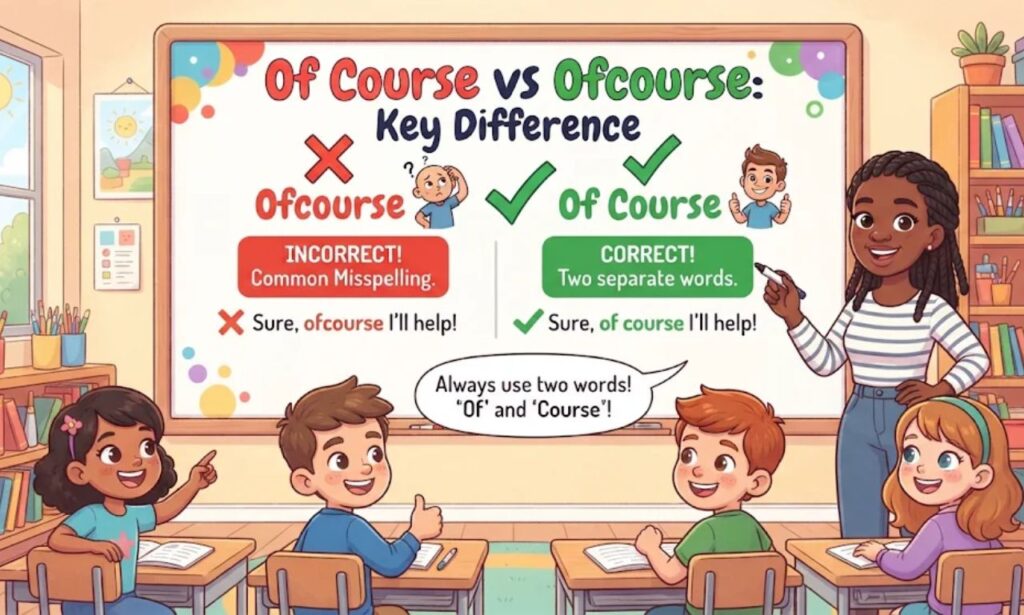
The central difference between “of course” and “ofcourse” comes down to standard usage versus an invalid spelling mistake. One is universally accepted across all forms of written English, while the other is an error caused by compounding words that should remain separate.
| Metric / Attribute | Of Course | Ofcourse |
| Grammatical Status | Standard prepositional phrase | Non-standard / Incorrect spelling |
| Word Count | Two distinct words | Single combined word (Error) |
| Dictionary Recognition | Recognized by all major dictionaries | Unrecognized in formal English |
| Primary Function | Adverbial modifier signaling expectation | None (Typographical error) |
| Acceptable Contexts | Academic, professional, and casual writing | None |
This breakdown clarifies why maintaining the space between the terms is essential for proper syntax and semantic processing in writing.
How to Use “Of Course” in a Sentence
Using “of course” effectively requires understanding its proper placement and punctuation within a sentence. Depending on where the phrase is positioned, punctuation rules dictate whether it should be set off by commas.
When “of course” appears at the start of a sentence as an introductory transition, it is followed by a comma. When placed in the middle of a sentence as an parenthetical expression, it should be enclosed by commas on both sides to separate it from the main clause.
When deciding between of course or ofcourse, always ensure you format the valid two-word phrase with correct punctuation based on its position:
- Introductory Position: Of course, we will review the document before submitting it.
- Mid-Sentence Parenthetical: The project, of course, requires final sign-off from the manager.
- End-of-Sentence Affirmation: You are welcome to join our study group, of course.
Of Course Examples in Sentences
To solidify your understanding of practical sentence structures, review these diverse examples across different conversational and narrative scenarios:
- She was nervous before the interview, but, of course, her extensive preparation paid off.
- “May I borrow your pen for a second?” “Of course! Take your time.”
- The team celebrated their success, which was, of course, well deserved after months of hard work.
- Of course, understanding of course or ofcourse is crucial for maintaining clear writing standards.
- The museum exhibits were impressive, though, of course, the main attraction remained the ancient artifacts.
- He promised to attend the meeting, and, of course, he kept his word.
These examples demonstrate how the phrase operates smoothly as a natural transition, emphasizing logical outcomes and polite affirmations.
Common Uses of Of Course
The phrase “of course” adaptively fulfills several pragmatic roles in written and spoken English discourse. Recognizing these common applications helps writers choose the appropriate tone and register for their target audience.
- Polite Affirmation: Responding to everyday favors or requests with a warm, welcoming tone.
- Emphasis of Fact: Highlighting undeniable logical facts within persuasive arguments or informative essays.
- Conversational Transition: Moving smoothly between interconnected ideas while maintaining cognitive flow.
- Sarcastic or Irony Marker: Signaling unexpected or humorous outcomes in informal creative storytelling.
Mastering these uses elevates conversational fluidness while ensuring that written expressions retain professional polish across contexts.
Is “Of Course” One Word or Two Words?
“Of course” is definitively two words. There is no standard context in English grammar where combining them into a single word is deemed correct. The term consists of the preposition “of” followed by the noun “course.”
Similar multi-word expressions in English frequently cause visual confusion for writers, leading to common compounding errors across various informal texts:
- In fact (often incorrectly written as infact)
- At least (often incorrectly written as atleast)
- Even though (often incorrectly written as eventhough)
- High school (often incorrectly written as highschool)
Keeping these terms separated ensures your prose complies with established editorial style guides, including APA, MLA, and Chicago Manual of Style guidelines.
Of Course in Formal and Informal English
While “of course” is grammatically valid in all registers, its tone can vary depending on whether it is used in formal academic papers or informal dialogue. In casual speech, it serves as a friendly, reassuring assent.
In formal business writing and academic research, however, writers should exercise restraint when using “of course” to state obvious facts. Overusing the phrase can sound condescending or overly informal to readers who expect an objective presentation of evidence.
When drafting formal reports, consider whether the statement genuinely requires “of course” or if presenting the evidence directly creates a stronger, more authoritative tone. In professional communications, resolving of course or ofcourse in favor of the correct two-word spelling ensures your correspondence retains credibility.
Common Mistakes With “Of Course”
Beyond combining the phrase into “ofcourse,” writers frequently make specific punctuation and stylistic errors when deploying “of course” in complex sentences.
- Missing Commas: Failing to set off mid-sentence parenthetical instances with enclosing commas, which disrupts sentence pacing.
- Overuse in Arguments: Repeating the phrase excessively to claim points are self-evident instead of providing supporting data.
- Incorrect Compound Forms: Accidentally typing “of-course” with a hyphen when used as a standard adverbial modifier.
- Redundant Phrasing: Combining “of course” with other assent words, such as “Yes, of course, certainly,” which creates repetitive syntax.
Addressing these minor stylistic missteps immediately improves overall clarity, visual appeal, and readability in formal documents.
Of Course vs Sure: What’s the Difference?
While both expressions communicate agreement or affirmation, “of course” and “sure” differ significantly in formality, tone, and semantic nuance. “Sure” is an informal conversational response that conveys casual acceptance, whereas “of course” carries stronger emphasis and higher formality.
Using “sure” in formal business writing or academic correspondence can appear overly casual. Conversely, using “of course” conveys absolute certainty and willingness, making it a stronger choice when validating important requests or emphasizing logical necessity.
Furthermore, “sure” primarily functions as an adjective or interjection, while “of course” functions strictly as an adverbial phrase. Selecting the appropriate option depends on the desired level of formality and the relationship between the speaker and the audience.
Of Course vs Certainly: What’s the Difference?
“Of course” and “certainly” are close synonyms used to express complete agreement or emphasize indisputable facts. However, “certainly” is a single-word adverb that fits seamlessly into highly formal, technical, or diplomatic registers.
“Certainly” often replaces “of course” when a writer wants to avoid any risk of sounding informal or presumptuous. For example, responding with “Certainly, I will handle that request immediately” sounds crisp and professional in executive communications.
Evaluating the choice between of course or ofcourse reminds writers that standard phrasing like “of course” or “certainly” guarantees stylistic accuracy, whereas improper forms diminish writing quality.
How to Remember the Correct Spelling
To consistently remember that “of course” must be written as two separate words, try using simple visual association and memory techniques:
- The Space Rule: Remember that a golf course requires a lot of open space; similarly, “of course” always needs a space in the middle.
- Substitution Test: Replace “course” with another noun, such as “of class” or “of nature.” Since you would never combine those words into single terms, you should never combine “ofcourse.”
- Two Words, Two Concepts: Remind yourself that “of” is a preposition and “course” is a noun—two distinct parts of speech that require two distinct words.
By implementing these straightforward memory devices, you can permanently eliminate the invalid form from your vocabulary and ensure your written English remains clear, accurate, and professional.
Conclusion
Mastering the distinction between of course or ofcourse is a small yet powerful step toward polishing your overall written communication. While digital communication often encourages fast, casual typing where spaces get overlooked, relying on the valid two-word phrasing ensures your writing maintains structural integrity. Consistently using standard English conventions prevents simple typographical errors from distracting your readers, allowing your core message and ideas to remain the central focus across every business email, essay, or published article.
By keeping the preposition and noun distinct, aligning your punctuation with proper sentence structure, and recognizing when to swap in formal alternatives like “certainly,” you elevate the quality and credibility of your prose. Eliminating accidental single-word compounds from your vocabulary reinforces strong writing habits that serve you well across all professional and creative spaces. Ultimately, taking the extra split second to insert that essential space guarantees your text remains clear, authoritative, and grammatically sound.

Abu Bakar is the admin of LifestyleABC.com with 3 years of experience in grammar and language content. He specializes in English grammar, synonyms, spelling, and word usage, creating clear and practical content to help readers improve their vocabulary and communication skills.