Have you ever stopped while typing because you weren’t sure whether to write Writing vs Writting? You’re not alone. Many students, bloggers, professionals, and English learners make this spelling mistake. Both forms look similar, but only one follows standard English spelling rules. Understanding the difference can improve your grammar and make your everyday communication clearer. The confusion usually happens because English has different rules for adding endings to verbs. Some words double their final consonants, while others simply lose a silent letter. Knowing when to apply these rules makes spelling much easier.
In this guide, you’ll learn the correct spelling, meaning, grammar rules, and practical examples. You’ll also understand why writing has one t and how to avoid this common mistake in the future.
Quick Answer
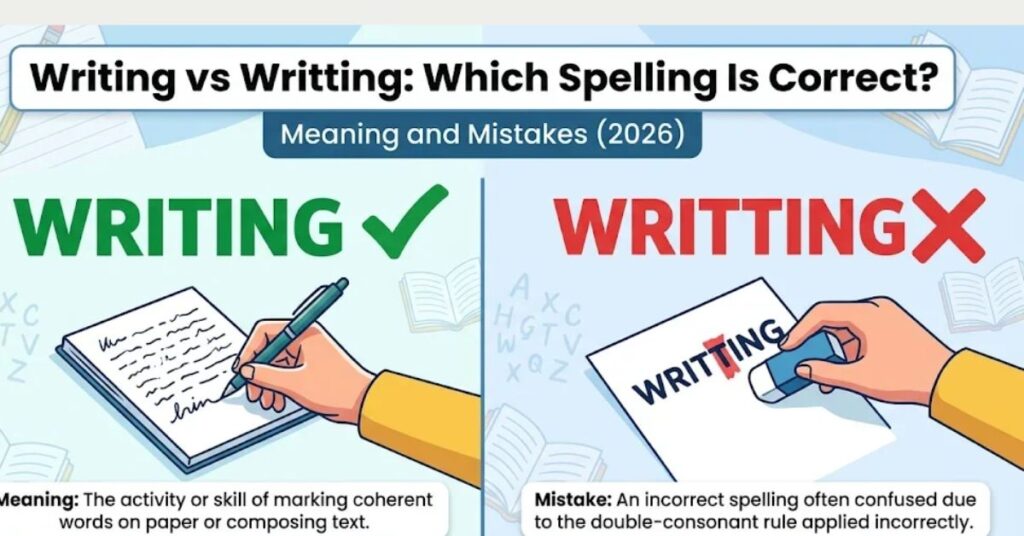
The correct spelling is writing, not writting. When you add the suffix -ing to the verb write, you remove its final silent e. You don’t add another t.
Here is the simple comparison of Writing vs Writting:
| Word | Correct? | Explanation |
|---|---|---|
| Writing | Correct | Standard English spelling |
| Writting | Incorrect | Contains an unnecessary extra t |
Remember: Always use writing with one t in academic assignments, emails, articles, business reports, and everyday messages.
For example:
- Correct: I am writing a new article.
- Incorrect: I am writting a new article.
What Does Writing Mean?
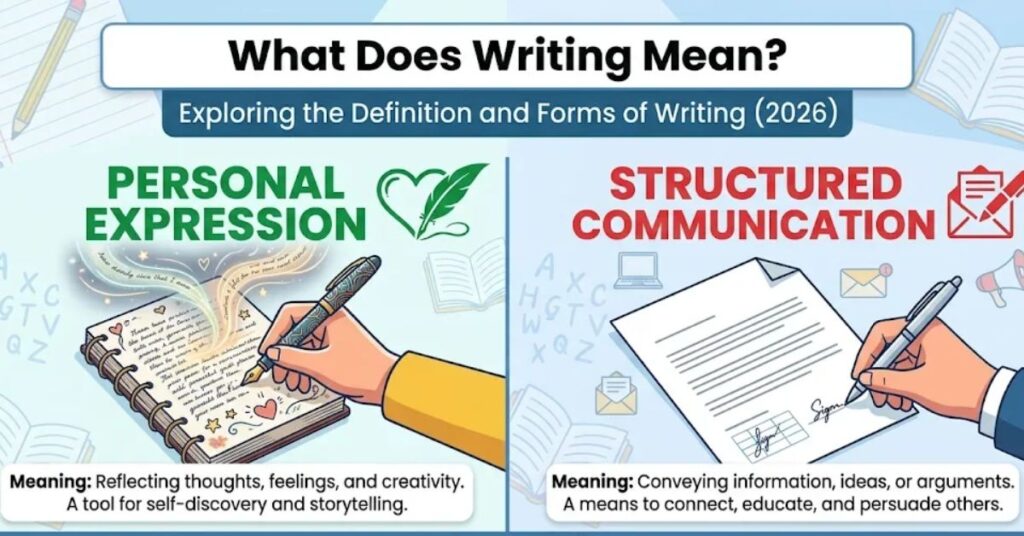
Writing is the -ing form of the verb write. It describes the action of putting thoughts, information, feelings, or ideas into words using a pen, keyboard, or another writing tool.
The word can also work as a noun. In that case, it refers to the activity of writing or the written material someone produces.
For example, when you say, I am writing an email, you’re describing an ongoing action. However, when you say, Her writing is beautiful, you’re talking about someone’s writing style or ability.
Writing appears in many areas of everyday life, including education, business, journalism, entertainment, and online communication.
Examples of Writing
Here are some natural examples showing how to use writing correctly:
- She is writing a letter to her grandmother.
- I enjoy writing short stories in my free time.
- He is writing a report for his manager.
- Good writing requires patience and regular practice.
- They are writing an article about English grammar.
- My brother is writing his college assignment.
Each sentence uses writing with one t. The word describes an activity or refers to the skill of producing written material.
What Does Writting Mean?
Writting is an incorrect spelling of writing. It isn’t accepted as a standard English word and has no separate meaning in conventional English dictionaries.
People commonly make this mistake because they confuse the spelling rule for adding -ing with another rule that doubles the final consonant.
For example, sit becomes sitting, so someone might assume that write should become writting. However, these verbs follow different spelling patterns.
The verb write already contains a final silent e. English spelling rules normally remove that e before adding -ing.
Therefore, the correct spelling is writing.
Incorrect
Incorrect spelling
- She is writting a letter to her friend.
- I love writting poems.
- He is writting an important business report.
Correct
Correct spelling
- She is writing a letter to her friend.
- I love writing poems.
- He is writing an important business report.
The difference is simple: remove the silent e and keep the original t.
Writing vs Writting: Comparison Table
Although writing and writting look almost identical, their spelling and grammatical status are different.
| Feature | Writing | Writting |
|---|---|---|
| Correct spelling | Yes | No |
| Standard English | Accepted | Not accepted |
| Meaning | Act or result of writing | No standard meaning |
| Verb form | -ing form of write | Incorrect form |
| Number of t’s | One | Two |
| American English | Correct | Incorrect |
| British English | Correct | Incorrect |
| Formal writing | Appropriate | Avoid |
The table makes the distinction clear. Writing is the only standard spelling in both American and British English.
Why Is Writing Correct?
The reason writing is correct comes from a basic English spelling rule. When a verb ends with a silent e, you usually remove that letter before adding the suffix -ing.
The original verb is write. Its final e doesn’t produce a separate sound, so English spelling removes it when forming the present participle.
Follow this simple pattern:
Write + ing → Writing
Notice that the original t stays in the word. Nothing requires you to double it.
This rule also applies to several everyday verbs. Learning these examples can help you recognize the same spelling pattern in other words.
Similar Examples
Consider these common examples:
| Base Verb | Correct -ing Form |
|---|---|
| Make | Making |
| Take | Taking |
| Give | Giving |
| Drive | Driving |
| Hope | Hoping |
| Move | Moving |
| Use | Using |
| Create | Creating |
| Complete | Completing |
| Write | Writing |
These examples demonstrate how English removes a final silent e before adding -ing.
Why Doesn’t Write Become Writting?
This confusion happens because English has another spelling rule called consonant doubling.
For certain short verbs ending in a consonant-vowel-consonant pattern, you double the final consonant before adding -ing.
For example:
- Sit → Sitting
- Run → Running
- Stop → Stopping
- Swim → Swimming
However, write doesn’t follow this pattern. It ends with a silent e, which changes how the suffix attaches to the word.
The correct spelling process is:
WRITE − E + ING = WRITING
The final e disappears, but the original t remains unchanged.
That’s why writting is incorrect. It adds an extra consonant without following the appropriate spelling rule.
Common Uses of Writing
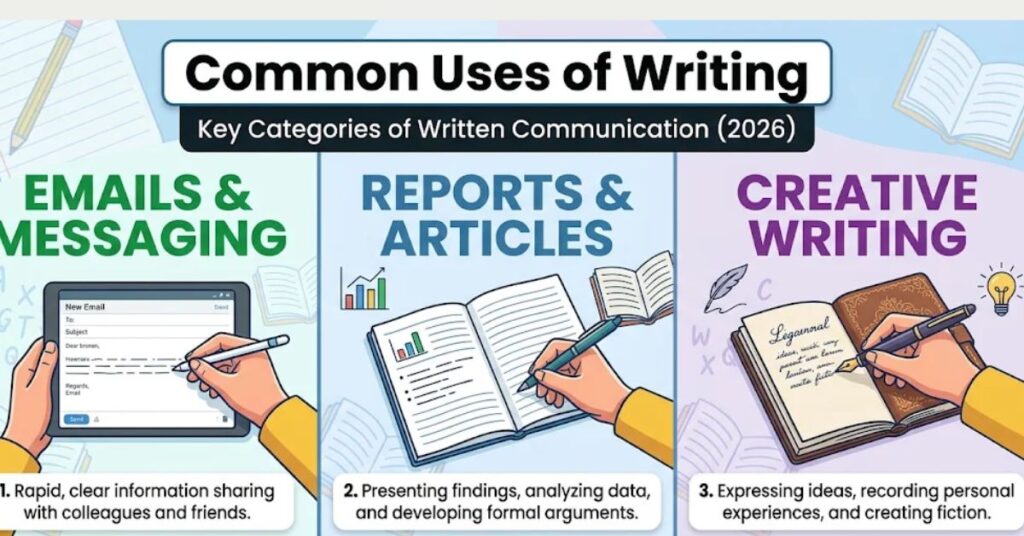
Writing is an important part of communication. People use it to share information, express creativity, complete professional tasks, and connect with others.
Here are some common situations where the word appears.
Academic Writing
Academic writing involves producing essays, research papers, assignments, summaries, and other educational materials.
Students use writing to explain ideas, present arguments, and demonstrate their understanding of different subjects.
Examples:
- She is writing an essay about climate change.
- Academic writing requires clear explanations.
- Students should practice writing regularly.
Creative Writing
Creative writing allows people to express their imagination through stories, poems, novels, scripts, and other literary forms.
Writers use descriptive language, characters, emotions, and storytelling techniques to connect with readers.
Examples:
- He enjoys writing mystery stories.
- Creative writing encourages imagination.
- She is writing a romantic novel.
Professional Writing
Professional writing focuses on workplace communication. It includes business reports, proposals, emails, presentations, and official documents.
Clear writing helps employees communicate information effectively and avoid misunderstandings.
Examples:
- She is writing a report for her company.
- Professional writing should remain clear and respectful.
- He is writing a business proposal.
Online Writing
Online writing includes blog posts, website articles, social media captions, newsletters, and digital content.
Content creators use writing to educate readers, share opinions, promote products, and communicate with online audiences.
Examples:
- She specializes in writing blog posts.
- Good writing can improve reader engagement.
- He is writing an article about English vocabulary.
Common Mistakes to Avoid
Spelling mistakes often happen when people type quickly or apply the wrong grammar rule. The best way to avoid them is to recognize the incorrect form and practice the correct spelling.
Here are some common examples.
Incorrect
I am writting an article about technology.
Correct
I am writing an article about technology.
Incorrect
She enjoys writting stories during her free time.
Correct
She enjoys writing stories during her free time.
Incorrect
Good writting takes time and practice.
Correct
Good writing takes time and practice.
Always remember that writing contains only one t. Checking your spelling before submitting an assignment or publishing an article can prevent this simple mistake.
Easy Memory Trick
Remembering the correct spelling doesn’t require complicated grammar lessons. A simple formula can help you avoid the mistake whenever you write.
WRITE − E + ING = WRITING
Remove the silent e. Keep the original t.
WRITE
WRITING
You can also remember this short rule:
One t in write, one t in writing.
Whenever you feel tempted to type writting, pause and think about the silent e. This small trick makes the correct spelling easier to remember.
Writing vs Written
Writing and written both come from the verb write. However, they perform different grammatical functions in English.
Understanding their difference helps you construct sentences correctly and avoid confusing verb forms.
Writing
Writing is the present participle or gerund form of write.
As a present participle, it describes an ongoing action. As a gerund, it functions like a noun.
Examples:
- She is writing a letter.
- Writing improves communication skills.
- They are writing their final assignments.
Written
Written is the past participle of write. It commonly appears with helping verbs such as has, have, and had. It can also work as an adjective.
Examples:
- She has written a beautiful story.
- I have written three emails today.
- Please follow the written instructions.
The main difference is that writing often describes an ongoing activity, while written commonly describes a completed action or something expressed in writing.
Writing vs Writting vs Written
These three forms can confuse English learners because they look similar. However, only two are correct.
| Word | Correct? | Example |
|---|---|---|
| Writing | Yes | I am writing a report. |
| Writting | No | Incorrect spelling |
| Written | Yes | I have written a report. |
Writing and written are legitimate English words with different grammatical functions. Writting is simply a misspelling.
If you’re describing an ongoing activity, use writing. If you’re using the past participle of write, use written.
American vs British English
Some English words have different spellings in American and British English. For example, Americans generally write color, while British English uses colour.
However, writing doesn’t have this regional spelling difference.
| American English | British English |
|---|---|
| Writing | Writing |
| Written | Written |
| Writting | Incorrect |
| Writer | Writer |
Both varieties use writing with one t.
Whether you’re preparing an American college assignment, writing a British business email, or publishing an international blog post, the correct spelling remains the same.
Related Words and LSI Keywords
Understanding related vocabulary can help you recognize different forms of the verb write and use them correctly.
Here are some useful words and expressions connected to writing:
| Related Word | Meaning |
|---|---|
| Write | To create words or text |
| Writer | A person who writes |
| Writing | The activity or result of writing |
| Written | Past participle of write |
| Wrote | Simple past tense of write |
| Written work | Material produced through writing |
| Essay writing | Creating structured essays |
| Creative writing | Writing imaginative content |
| Academic writing | Formal educational writing |
| Professional writing | Workplace-related writing |
| Content writing | Producing digital or marketing content |
| Writing skills | Abilities used to communicate through text |
| Writing style | A person’s way of expressing ideas |
| Written communication | Sharing information through text |
These related terms provide useful context when learning English grammar, vocabulary, and spelling.
Expert Writing Tip
One useful way to improve your spelling is to understand why certain words change when you add suffixes.
For write, the rule is straightforward: remove the final silent e before adding -ing.
However, don’t apply this rule to every verb. Some words follow different patterns.
For example:
- Write → Writing
- Make → Making
- Run → Running
- Sit → Sitting
- Lie → Lying
Notice how the spelling changes depending on the original verb.
If you’re learning English or improving your professional writing skills, practice these patterns with short sentences. Reading your work aloud and using a spellchecker can also help you identify mistakes.
Most importantly, remember that spellcheckers are useful tools, but understanding grammar rules gives you greater confidence.
Frequently Asked Questions
Does writing have one or two t’s?
Writing contains one t. The final silent e in write disappears before adding the -ing suffix.
Why is the e removed in writing?
English generally removes a verb’s final silent e before adding -ing. Therefore, write becomes writing.
What is the difference between writing and written?
Writing describes an ongoing action or activity, while written is the past participle of the verb write.
Is writing spelled the same in American and British English?
Yes. Both American and British English use writing with one t. There is no regional spelling difference.
How can I remember the correct spelling?
Use the formula WRITE − E + ING = WRITING. Remove the silent e without adding another t.
Is writting a common mistake?
Yes. Many learners accidentally double the t because they confuse writing with words such as sitting and running.
Summary
The correct spelling is writing, not writting. Both forms may look similar, but only writing follows standard English spelling rules. It is the -ing form of the verb write and describes the process of creating words, sentences, stories, articles, and other written material. You can use it in academic writing, creative writing, professional communication, and everyday conversations.
The easiest way to remember the difference is WRITE − E + ING = WRITING. Simply remove the final silent e without adding another t. Whether you’re preparing an assignment, sending an email, creating blog content, or improving your English grammar, always use writing with one t. Small spelling details can make your communication clearer and more professional. Practice this rule regularly, and you’ll avoid this common mistake with confidence.

Abu Bakar is the admin of LifestyleABC.com with 3 years of experience in grammar and language content. He specializes in English grammar, synonyms, spelling, and word usage, creating clear and practical content to help readers improve their vocabulary and communication skills.