

Have you ever wondered whether to write Company-Wide vs Companywide in a business email, professional report, resume, or company policy? Both spellings are widely used, and their similarities can make it difficult to determine which form is correct.
The good news is that both companywide and company-wide are accepted English spellings. They share the same meaning: something that affects, involves, or extends throughout an entire company.
However, if you want a simple and modern spelling choice, companywide is an excellent default for professional and general writing. The hyphenated form, company-wide, remains common and appropriate, particularly when an organization or style guide prefers hyphenation.
In this guide, you’ll learn the difference between companywide and company-wide, their meanings, grammatical usage, examples, common mistakes, and which spelling works best in American English.
Quick Answer:Company-Wide vs Companywide?
Companywide and company-wide are both correct. They mean throughout the entire company or involving all employees, departments, or operations of a company.
- Companywide: A closed compound written as one word. It is a clean, modern choice for business and professional writing.
- Company-wide: A hyphenated compound with exactly the same meaning. It remains widely used and accepted.
- Company wide: Generally less preferred when the expression functions as a compound adjective or adverb.
For most modern business writing, companywide is a practical default. If your employer, publisher, or style guide uses company-wide, follow that preference consistently.
What Does Companywide Mean?
Companywide is an adjective or adverb that describes something affecting, involving, or extending throughout an entire company.
It can refer to employees, policies, training programs, announcements, meetings, surveys, changes, and business operations.
Examples of Companywide in Sentences
- The company introduced a companywide training program.
- Management announced a companywide restructuring.
- The new policy applies companywide.
- Employees must complete the companywide training course.
- A companywide meeting will take place next Monday.
- The software update will be available companywide next month.
- The organization adopted a companywide communication strategy.
- The new safety standards apply companywide.
- The survey was distributed companywide.
- The company launched a companywide employee engagement initiative.
Companywide in Simple Words
Think of companywide as:
Companywide = Throughout the entire company
For example:
“The new policy applies companywide.”
This means the new policy applies throughout the entire company, rather than only to one department or location.
What Does Company-Wide Mean?
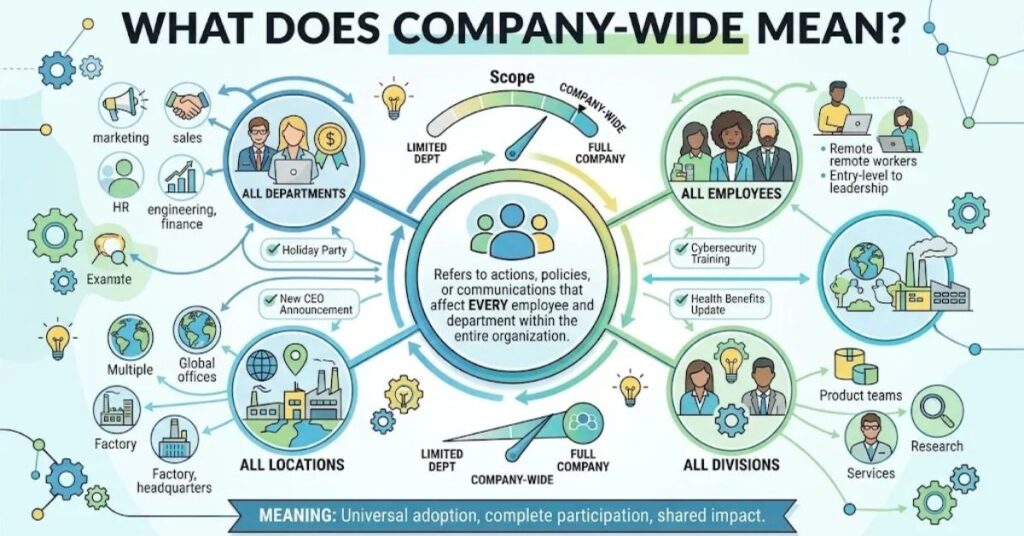
Company-wide is the hyphenated version of companywide. It has the same meaning and can be used in the same grammatical situations.
The hyphen visually connects company and wide, making the compound structure immediately clear to readers.
Examples of Company-Wide in Sentences
- The company launched a company-wide training program.
- We need a company-wide solution to the problem.
- Management announced a company-wide initiative.
- A company-wide meeting is scheduled for Friday.
- The organization introduced a company-wide policy.
- Employees received a company-wide announcement.
- The company-wide standards will take effect next month.
- The survey was conducted company-wide.
- The new procedure will be applied company-wide.
- The changes will affect employees company-wide.
These examples demonstrate that company-wide works naturally in professional communication, business documents, and everyday writing.
Companywide vs Company-Wide: Comparison Table
| Feature | Companywide | Company-Wide |
|---|---|---|
| Spelling | One word | Hyphenated |
| Meaning | Throughout the entire company | Throughout the entire company |
| Grammar | Adjective or adverb | Adjective or adverb |
| Usage | Modern general and business writing | Professional and editorial writing |
| Correctness | Accepted | Accepted |
| Recommendation | Strong modern default | Accepted alternative |
The main difference is spelling style, not meaning. Neither form communicates a different level of importance, scope, or authority.
When Should You Use Companywide?
Companywide is a practical choice when you want a concise, professional, and modern spelling.
It works particularly well in business writing, including:
- Corporate emails
- Employee handbooks
- Company policies
- Business reports
- Job descriptions
- Internal announcements
- Professional resumes
- Marketing materials
- Organizational communication
Examples
Business communication:
The change will be implemented companywide next quarter.
Employee training:
We are conducting a companywide survey to evaluate employee satisfaction.
Corporate policy:
The new attendance policy applies companywide.
Professional resume:
Led a companywide employee engagement initiative involving multiple departments.
Business announcement:
Management introduced a companywide initiative to improve workplace communication.
In these examples, companywide clearly communicates that the action or policy extends across the entire organization.
When Should You Use Company-Wide?
Use company-wide when your organization, publisher, or preferred style guide requires or favors the hyphenated form.
The hyphenated spelling is not incorrect, outdated, or unprofessional. It remains a familiar choice in many business documents and publications.
Examples
- The company launched a company-wide development program.
- We need a company-wide approach to customer service.
- The company-wide policy will take effect in January.
- Management approved a company-wide communication strategy.
- A company-wide meeting will be held next week.
If your organization consistently uses company-wide, there is no reason to change it simply because another writer prefers companywide.
The most important rule is consistency.
Is Companywide One Word?
Yes. Companywide is an established one-word compound meaning throughout the entire company.
It is commonly used as an adjective before a noun or as an adverb modifying an action.
Examples
- A companywide initiative
- A companywide policy
- A companywide announcement
- A companywide training program
- The policy applies companywide.
The closed form is concise and easy to recognize, making it particularly useful in modern business writing.
Is Company-Wide Incorrect?
No. Company-wide is also an accepted and widely used spelling.
The hyphenated form communicates exactly the same meaning as companywide.
For example:
“The company introduced a company-wide policy.”
This sentence is correct and appropriate for professional communication.
The preference between companywide and company-wide generally depends on editorial style, organizational preference, or the dictionary being followed.
Should You Use Companywide or Company-Wide on a Resume?

Both spellings are acceptable on a resume, but companywide is a clean modern option.
Resume writing generally benefits from concise, direct language, and companywide fits naturally into achievement statements.
Resume Examples
- Led a companywide employee engagement initiative.
- Developed a companywide training program.
- Coordinated companywide communication efforts.
- Implemented companywide process improvements.
- Supported a companywide software rollout.
You can also use company-wide if that spelling matches your organization’s terminology or your resume’s established style.
The key is to maintain consistency and communicate your accomplishments clearly.
Is Company Wide Two Words Correct?
When companywide or company-wide functions as a compound adjective before a noun, the closed or hyphenated spelling is generally clearer.
Less Preferred
The company wide policy was announced yesterday.
Preferred
The companywide policy was announced yesterday.
Or:
The company-wide policy was announced yesterday.
However, two separate words can appear in grammatical constructions where company and wide function independently.
For example:
“The company grew wide in its geographic reach.”
Here, wide is a separate descriptive word rather than part of the compound companywide.
In ordinary business writing, use companywide or company-wide when you mean throughout the entire company.
Common Mistakes to Avoid
1. Assuming Only One Spelling Is Correct
One of the most common mistakes is believing that companywide is correct and company-wide is always wrong, or vice versa.
Both spellings are established in English usage.
Choose the form that matches your preferred style guide or organizational standards.
2. Using Company Wide Automatically
When the expression describes a policy, program, initiative, or other company-level activity, companywide or company-wide is generally the better choice.
For example:
- Companywide training program
- Company-wide employee policy
- Companywide announcement
- Company-wide initiative
These forms are clearer and more conventional in professional writing.
3. Switching Between Spellings
Avoid using both forms randomly in the same document.
For example:
“The company launched a companywide program and later announced a company-wide initiative.”
Although the sentence is understandable, switching spellings without a reason can make your writing look inconsistent.
Choose one form and use it throughout your document.
4. Confusing Meaning With Spelling
Companywide and company-wide do not have different meanings.
Both describe something involving or affecting the entire company.
The hyphen does not change the scope, importance, or meaning of the expression.
A Simple Memory Trick
Remember this formula:
COMPANY + WIDE = THE WHOLE COMPANY
If something affects the entire company, describe it as companywide.
For example:
A companywide policy means a policy that applies throughout the company.
You can also remember the pattern:
- Nationwide
- Worldwide
- Citywide
- Industrywide
- Companywide
Many familiar compounds using the suffix -wide appear as one word in modern English.
Companywide vs Company-Wide in American English
In American English, both companywide and company-wide are used.
There is no major difference in meaning between American and British English for these spellings. However, dictionaries, publishers, employers, and editorial style guides may differ in their preferred forms.
For American business writing, companywide is a practical modern default because it is concise and widely established.
If you are writing for a specific publication, university, employer, or website, follow its spelling conventions.
Similar Words That Use the -Wide Suffix
The suffix -wide generally means extending throughout a particular place, group, industry, or system.
Here are several related compounds that help illustrate the pattern.
| Word | Meaning | Example |
|---|---|---|
| Nationwide | Throughout an entire nation | The program launched nationwide. |
| Worldwide | Throughout the world | The product is available worldwide. |
| Citywide | Throughout an entire city | The city introduced a citywide recycling program. |
| Industrywide | Throughout an entire industry | The change could have industrywide effects. |
| Organizationwide | Throughout an entire organization | The organization implemented an organizationwide policy. |
| Department-wide | Throughout an entire department | The manager announced a department-wide training session. |
Notice that not every -wide compound follows the same spelling preference. Some are commonly closed, while others frequently retain a hyphen.
When in doubt, consult the relevant dictionary or style guide.
Companywide vs Company-Wide: Frequently Asked Questions
Is companywide one word?
Yes. Companywide is a standard closed compound meaning throughout the entire company. It is commonly used in professional and business writing.
Is company-wide correct?
Yes. Company-wide is an accepted hyphenated spelling with the same meaning as companywide.
Which is more correct: companywide or company-wide?
Both are correct and widely understood. Companywide is a strong modern default, while company-wide remains an accepted alternative. The preferred form depends on the relevant style guide or editorial preference.
Should I write companywide with a hyphen?
Not necessarily. Companywide is widely accepted without a hyphen. Use company-wide if your organization or style guide prefers the hyphenated spelling.
Is company wide two words correct?
When the expression means throughout the entire company, companywide or company-wide is generally clearer and more conventional.
What does companywide mean?
Companywide means affecting, involving, or extending throughout the entire company, including its employees, departments, or operations.
Is companywide formal?
Yes. Companywide is suitable for professional, formal, academic, and business writing.
Is companywide an adjective or an adverb?
Companywide can function as both.
As an adjective:
“The company introduced a companywide policy.”
As an adverb:
“The policy applies companywide.”
Can I use companywide in a business email?
Yes. Companywide is appropriate for business emails, internal announcements, corporate policies, and professional communication.
Should I use companywide in a job description?
Yes. Companywide works naturally in job descriptions when describing responsibilities, policies, programs, or initiatives that extend throughout an organization.
Final Verdict: Company-Wide vs Companywide
The choice between companywide and company-wide is primarily a matter of spelling convention and style rather than meaning.
Both forms communicate the same basic idea: something that affects, involves, or extends throughout an entire company.
For modern general and business writing, companywide is a strong default because the closed compound is concise, established, and increasingly familiar.
However, company-wide remains a legitimate and widely used alternative, especially when a style guide or organization prefers hyphenation.
If you are unsure which spelling to choose, use companywide unless your employer, publisher, or preferred style guide specifically recommends company-wide.
Remember This
- Companywide: Modern closed compound; a strong default.
- Company-wide: Accepted hyphenated alternative.
- Company wide: Generally avoid when intended as a compound modifier.
Best modern default: Companywide.
The simplest rule is to choose one spelling and use it consistently throughout your writing.
Written by Arman Lexford, a linguist specializing in word relationships and vocabulary building. His work focuses on making language learning simple, precise, and engaging.

Abu Bakar is the admin of LifestyleABC.com with 3 years of experience in grammar and language content. He specializes in English grammar, synonyms, spelling, and word usage, creating clear and practical content to help readers improve their vocabulary and communication skills.